

Nurturing Intimacy: Love, Vulnerability, and Emotional Safety in Men's Lives

The kitchen still smelled of garlic and rosemary when Marcus set down his fork. Across the small oak table, his wife Priya was describing something about her day, a difficult conversation with a colleague, maybe, but Marcus found himself only half-listening. His mind kept circling back to the knot that had been tightening in his chest for weeks. Something he couldn't name. Something he didn't know how to say.
"Thanks for dinner," he managed, the words feeling inadequate even as they left his mouth. "It was really good."
Priya paused, studying him. After twelve years of marriage, she had learned to read the silences between his sentences. "You, okay?"
Marcus started to nod, the automatic response, the one that had served him well through four decades of being a man in a world that expected strength without cracks. But tonight, something shifted. Maybe it was the soft evening light falling through the window, or the way Priya's hand rested near his on the table, patient and unhurried. Maybe it was simply exhaustion from carrying something alone for too long.
"I've been scared," he said, the admission so quiet he almost hoped she hadn't heard. "About us. About whether I'm... enough. For you. For the kids. I keep thinking I should have more figured out by now."
The words hung in the air, naked and strange. Marcus felt his face flush, a rush of vulnerability that made him want to retreat into safer territory, a joke, a change of subject, anything to restore the familiar armour. But Priya didn't laugh or look away. Instead, she reached across the table and covered his hand with hers.
"I didn't know you were carrying that," she said softly. "Thank you for telling me."
In that moment, something released in Marcus's chest. Not a solution to his fears, but perhaps something more valuable: the knowledge that he didn't have to hold them alone. They sat together in the quiet kitchen, the dinner dishes forgotten, and for the first time in months, Marcus felt genuinely close to the woman he had promised to love for a lifetime.
The Landscape of Connection
Marcus's struggle, the desire for closeness wrestling with the fear of exposure, is not his alone. It echoes through the lives of millions of Canadian men who navigate the complex terrain of intimate relationships while carrying the weight of expectations that rarely leave room for tenderness.
The statistics paint a portrait of a nation in transition. By 2021, over 22% of Canadian couples were living in common-law relationships, the highest rate among G7 countries, with 77% of couples aged 20-24 choosing cohabitation over marriage (Statistics Canada, 2022). Only 44% of Canadians aged 15 or older were married in 2021, down from 54% three decades earlier (Statistics Canada, 2022). These numbers suggest not a rejection of partnership, but perhaps a generation searching for new ways to build it, ways that might finally make room for authenticity.
Yet even as the forms of partnership evolve, the yearning for deep connection remains. When the Angus Reid Institute (2018) surveyed Canadian attitudes toward marriage, they found something revealing. While 53% of respondents believed marriage was "simply not necessary," a majority still viewed common-law relationships as a "lesser form of commitment." Among men aged 25-34 who chose to marry, 52.4% named "proof of love and commitment" as their primary motivation (Cardus, 2020; Nussbaum, 2025). Behind the shifting statistics lies an enduring human truth: we want to be seen, known, and loved, not despite our imperfections, but within them.
The stakes of this longing extend far beyond emotional satisfaction. Research consistently demonstrates that fulfilling relationships function as a powerful protective factor for mental and physical health. People who maintain strong social connections tend to be happier, physically healthier, and live longer, with significantly fewer mental health challenges (Government of Canada, 2019). High marital quality correlates with reduced stress and lower rates of depression, while toxic or high-conflict relationships can be more damaging to mental health than being single (Mental Health Foundation, n.d.). Depression affects a substantial portion of the Canadian population, making the cultivation of supportive relationships a critical public health priority (Centre for Addiction and Mental Health [CAMH], n.d.). For men specifically, who are three times more likely than women to die by suicide and who comprise 72% of opioid toxicity deaths in Canada, the health benefits of genuine connection are not abstract; they are lifesaving (Health Canada, 2026).

The Walls We Build
Understanding why intimacy often feels so difficult for men requires excavating the cultural soil in which modern masculinity grows. From childhood, boys receive persistent messages about what emotions are acceptable to display. Phrases like "boys don't cry" and "man up" serve as powerful directives, teaching young men that certain feelings, sadness, fear, vulnerability, and hurt, represent weakness rather than humanity (Suri and Srishti, 2025). These expectations create what researchers describe as the internal and relational barriers of hegemonic masculinity, a framework that prizes stoicism, competition, and emotional control above all else (Fyfe, 2021).
Kofi remembers the moment he learned this lesson. At seven years old, he had fallen hard during a soccer game at his school in Scarborough, scraping his knee badly enough to draw blood. When tears began to well in his eyes, his coach, a kind man who genuinely cared about his players, pulled him aside. "You're tough, Kofi. Shake it off." There was no malice in the words, only the inherited wisdom of generations who believed that toughness and emotional expression could not coexist.
Now at twenty-three, Kofi sits across from his girlfriend Mia in a quiet café, struggling to explain why he sometimes goes quiet and distant. The truth, that he fears not being successful enough, smart enough, worthy enough of her love, feels impossible to articulate. Somewhere along the way, the vocabulary for such admissions got lost.
This phenomenon, which psychologists term emotional illiteracy, affects countless men who were never taught the language of their inner lives (Suri and Srishti, 2025). When boys are not encouraged to identify, name, and articulate their feelings during their formative years, doing so in adult relationships becomes extraordinarily difficult. Complex emotions such as grief, guilt, and tender longing may remain unspoken and unresolved, creating distance and misunderstandings between partners (Sigafus and Rutherford, n.d.).
The consequences ripple outward. Men default to a limited range of emotional expressions, anger, withdrawal, or hyper-focus on problem-solving, which are more socially tolerated but serve as poor substitutes for genuine communication (Sigafus and Rutherford, n.d.). Partners feel shut out. Trust erodes. The very intimacy men often desperately want becomes increasingly difficult to access.
Yet emotional literacy is not fixed at birth. It is a skill, and like any skill, it can be developed. Research demonstrates a strong correlation between emotional intelligence, the ability to understand and manage one's own emotions and recognize those of others, and healthy relationships (Amin et al., 2025). The question is not whether men can learn to speak the language of intimacy, but whether they will find the courage and support to begin.
Wisdom from the Circle
Long before contemporary psychology articulated the importance of emotional connection, Indigenous peoples across Turtle Island understood that human beings are fundamentally relational creatures. The First Nations concept of kinship extends far beyond the nuclear family model that dominates Western thinking. Among many nations, kinship systems encompass entire communities, forming the essential foundation for identity, belonging, and mutual responsibility (Family Research Council, n.d.).
The Cree concept of wahkohtowin, which emphasizes relatedness, illustrates a vision of connection that transcends blood ties, creating a deep, interconnected sense of family (Burke, 2023). In this understanding, no individual stands alone. To be human is to be woven into a web of relationships that nourish, challenge, and sustain.
Among the Blackfoot (Niitsitapiiksi), traditional family structures embodied this relational worldview. Marriage was understood not merely as a bond between two individuals, but as a connection that integrated families and strengthened the entire community (Song, n.d.). Love and intimacy were understood within a framework of communal well-being and spiritual integrity, personal relationships interwoven with social roles, economic necessity, and sacred obligations.
These Indigenous perspectives offer a profound counter-narrative to the hyper-individualism that often characterizes contemporary Western approaches to relationships. They remind us that the capacity for intimacy is not developed in isolation but is nurtured within communities that model vulnerability, reciprocity, and care. As men's organizations increasingly recognize, brotherhood itself becomes a training ground for emotional connection skills.
Colonial policies explicitly attempted to dismantle these powerful kinship structures, yet they have shown remarkable resilience (Family Research Council, n.d.). Indigenous communities continue to teach what many men are only now rediscovering: that connection is not a weakness to be overcome, but a strength to be cultivated.

The Body Remembers
At sixty-seven, Walter had spent most of his life believing that love was something you demonstrated through action, not words. Raised on a farm outside Edmonton, he learned early that a man's worth was measured by what he could build, fix, and provide. Emotions were private matters, best kept tucked away where they couldn't interfere with the work that needed doing.
His wife Margaret had accepted this arrangement for decades, finding her own ways to interpret his silences. But after his heart attack last spring, something changed. Lying in the hospital bed, monitors beeping softly in the dim room, Walter found himself gripping Margaret's hand with a ferocity that surprised them both.
"I should have told you more," he whispered, his voice thick. "How much you mean to me. I always thought there'd be time."
Margaret leaned close, tears streaming down her face. "There's still time, Walter. There's still time."
Walter's awakening, prompted by a brush with mortality, aligns with what researchers have increasingly documented: the profound connections between intimate relationships, physical health, and longevity. Regular sexual activity and physical intimacy serve as moderate exercise, benefiting cardiovascular health by strengthening the heart, improving circulation, and lowering blood pressure (Schreiner, 2025). Studies have shown that men who maintain active intimate lives may significantly reduce their risk of heart disease (Vella, 2024).
Physical closeness also serves as a powerful stress reducer. The release of hormones such as oxytocin and endorphins during intimate contact counteracts cortisol, the stress hormone whose chronic elevation damages multiple organ systems (Vella, 2024). A compelling Welsh study found that mortality risk was 50% lower among men with high orgasmic frequency compared to those with low frequency (Vella, 2024). While frequency matters, research suggests that the quality of the intimate relationship and the emotional connection may be even more critical; it is not merely the physical act, but the context of safety and love within which it occurs (Vella, 2024). Longitudinal research has found that the enjoyment of sexuality, particularly when perceived as an important part of life, is positively associated with longevity in late midlife and older adults (Beerepoot et al., 2022).
The implications are striking; nurturing intimacy is not merely an emotional luxury but a fundamental component of men's health. The Canadian Men's Health Foundation has increasingly emphasized this holistic approach, recognizing that men's physical, mental, and relational well-being are deeply interconnected (Canadian Men's Health Foundation, n.d.). In 2026, the Government of Canada launched a national conversation to inform the country's first Men and Boys' Health Strategy, acknowledging that improving men's health requires addressing the full spectrum of their needs, including the capacity for meaningful connection (Health Canada, 2026).
Learning the Language
For Kofi, the turning point came unexpectedly. A friend had invited him to a men's circle, a small group that met monthly in the basement of a community centre to talk about their lives. Kofi had resisted at first. The idea of sitting in a circle, sharing feelings, sounded exactly like the kind of thing that would make him uncomfortable.
But something about his friend's persistence, combined with his growing frustration in his relationship with Mia, finally convinced him to try. At the first meeting, he mostly listened. A construction worker in his fifties talked about caring for his aging mother. A young teacher described the pressure of trying to be perfect for everyone. A retired engineer, his voice breaking, shared his loneliness after his wife's death.
No one tried to fix anyone. No one offered advice unless asked. The men witnessed each other's experiences, and in that witnessing, something happened that Kofi couldn't quite name. By the end of the evening, he found himself speaking, haltingly at first, then with growing confidence, about his fears of not being enough for Mia.
"It's like I have all these feelings," he said, "but I don't have the words. And when I can't find the words, I just... shut down."
The older man beside him nodded. "I spent forty years shutting down," he said quietly. "Don't wait as long as I did."
What Kofi discovered in that basement circle reflects what researchers term sexual health literacy and its broader cousin, emotional intelligence. Sexual health literacy involves the ability to access, understand, and use information to make informed decisions about one's intimate life (Amin et al., 2025). But knowledge alone is often insufficient. Research highlights the critical mediating role of emotional intelligence: individuals with higher emotional intelligence are better able to translate their knowledge into effective communication with partners, expressing their needs and boundaries clearly while responding to their partner's concerns with empathy (Amin et al., 2025).
This intersection of emotional and sexual literacy matters profoundly. When men can articulate their feelings, they become capable of the kind of vulnerable communication that deepens trust. They can navigate the potentially awkward conversations about desires, boundaries, and fears that characterize mature intimate relationships. They can say, as Marcus finally said to Priya, "I've been scared", and in saying it, open a door that had seemed permanently closed.
Practice: The Heart Check-In
One powerful tool for developing this capacity is a Heart Check-In, as relationship therapists call it. This brief daily practice cultivates awareness of both your own emotional state and your appreciation for your partner.
Before reuniting with your partner at the end of the day, take five minutes in a quiet space. This might be in your car after parking, on a bench outside your home, or in a private corner at work. Close your eyes and place your hand on your chest. Take three slow breaths.
Ask yourself: What am I feeling right now? Don't judge the answer or try to fix it. Notice. Tired? Anxious? Hopeful? Frustrated? Let the feeling have a name.
Then shift your attention: What is one thing I genuinely appreciate about my partner? Not a generic quality, but something specific, the way she laughed at breakfast, how he remembered to pick up milk, the fact that she listened when you needed to vent.
Carry these two awarenesses, your emotional truth and your gratitude, into your reunion. You don't need to deliver a speech. Simply entering the space with conscious awareness of your inner world and intentional appreciation for your partner shifts the quality of connection.
Over time, this practice builds emotional literacy. You become fluent in recognizing your own feelings, skilled at noticing what you value in your partner, and more capable of articulating both.

The Courage of Tenderness
The journey toward greater intimacy inevitably encounters a formidable guardian: fear. Fear of rejection. Fear of being seen as weak. Fear that if we reveal our true selves, we will be found wanting.
For many men, these fears run deeper than simple self-protection. They are rooted in experiences, often early ones, where vulnerability was met with dismissal, ridicule, or shame. When a man risks sharing his insecurities and is met with mockery or indifference, the resulting wound can teach a lesson that lasts for decades: it is safer to remain silent (Suri and Srishti, 2025).
This is why cultivating emotional safety, both within oneself and in relationships, is so essential. Emotional safety is the felt sense that one can express authentic feelings without fear of negative consequences. It is what allows Marcus to finally tell Priya about his fears, what enables Kofi to speak honestly in his men's circle, and what permits Walter to say the words he had held back for a lifetime.
Creating this safety requires courage from all parties. For the person sharing, it means accepting the risk of exposure. For the person receiving, it means responding with presence rather than judgment, with curiosity rather than defensiveness, and with empathy rather than advice.
Research suggests that vulnerability is not an inherent trait but a learned skill (Manhattan Wellness, n.d.). It can begin with small steps: sharing a minor worry with a trusted friend, admitting uncertainty instead of pretending certainty, asking for help when you genuinely need it. Each small act of vulnerability, when met with acceptance, builds evidence that openness is survivable, even enriching.
Partners can support this process by modelling their own emotional openness, creating non-judgmental space, and celebrating efforts toward vulnerability rather than expecting perfection (Weigel, 2023). When a man says something like, "I'm not sure how to put this, but..." the response that follows will either encourage future vulnerability or extinguish it.
Practice: Active Listening and Reflection
One of the most powerful gifts we can offer a partner, and one of the most challenging skills to develop, is genuine listening. Not listening while formulating a response. Not listening to find an opportunity to share our own story. Not listening to fix or solve, and simply listening to understand.
Try this exercise with your partner. Sit facing each other. One person speaks for three minutes about something on their mind, a challenge at work, a fear about the future, or a hope for their relationship. The other person listens without interrupting.
When the speaker finishes, the listener does not offer advice or perspective. Instead, they reflect what they heard: "It sounds like you're feeling overwhelmed by the pressure at work, and you're worried it's affecting our time together. You're hoping we can find a way to protect our evenings."
The speaker then clarifies or confirms. Switch roles.
This simple practice, speaking and being truly heard, builds the muscle of emotional presence. It teaches both partners that their inner worlds matter and can be shared safely. Over time, it transforms the relationship into a space where both people can be fully known.
Beyond the Bedroom
Though this article has explored sexual intimacy and physical connection, the broader territory of intimacy extends far beyond the bedroom. It encompasses the daily moments of turning toward rather than away: asking about your partner's day and genuinely listening to the answer, noticing when they seem burdened and offering support, sharing your own struggles instead of carrying them alone.
For single men navigating the dating landscape, intimacy begins with the willingness to be authentic even in early conversations. This doesn't mean overwhelming a first date with your deepest fears and wounds. It means allowing yourself to be genuinely curious about another person, sharing something real about your own hopes and uncertainties, choosing connection over performance.
Amir, thirty-one and recently re-entering the dating world after a long relationship ended, had developed a habit of presenting a polished version of himself on dates. Successful career. Active social life. Everything under control. The dates went fine, but they rarely led to a genuine connection.
Then a friend offered some unexpected advice: "What if you told someone about your actual life? The messy parts. The things you're still figuring out."
On his next date, when Maya asked what he was looking for, Amir surprised himself by answering honestly. "I'm hoping to find someone I can really know, and who really knows me. My last relationship ended because we were both pretending to be people we weren't. I'm trying not to do that anymore."
The conversation that followed was unlike any first date he'd had. Vulnerable. Curious. Real. It wasn't magic; not every date leads to love, but it was a beginning. And beginnings built on truth have better chances of lasting.
Consent and clear communication form the essential foundation for intimate exploration at any stage. This means not only asking for and receiving permission for physical intimacy but also creating ongoing dialogue about desires, boundaries, and comfort. Normalizing consent language, "Is this okay?" "What would feel good for you?" "I'd love to try this; how do you feel about it?", transforms intimacy from guesswork into collaboration.
Practice: The Consent Conversation
Many men feel awkward initiating explicit conversations about consent and desires, particularly within established relationships. The following approach can help normalize these discussions.
Choose a calm moment, not during physical intimacy, but perhaps over coffee or during a quiet evening. Begin by expressing your intention: "I've been thinking about how we communicate about intimacy, and I want to make sure you always feel comfortable telling me what you want and don't want."
Ask open-ended questions: "Is there anything I do that you'd like more of? Less of? Something we haven't tried that you might be curious about?"
Listen without defensiveness. If your partner shares something that surprises or challenges you, resist the urge to justify or explain. Instead, thank them for trusting you with their truth.
Share your own desires and boundaries. Model the vulnerability you're inviting.
End by affirming your commitment to ongoing dialogue: "I want us to be able to talk about this stuff whenever we need to. You can always tell me if something isn't working."
This conversation, and the ones that follow, build a culture of consent and communication that makes physical intimacy safer and more satisfying for both partners.
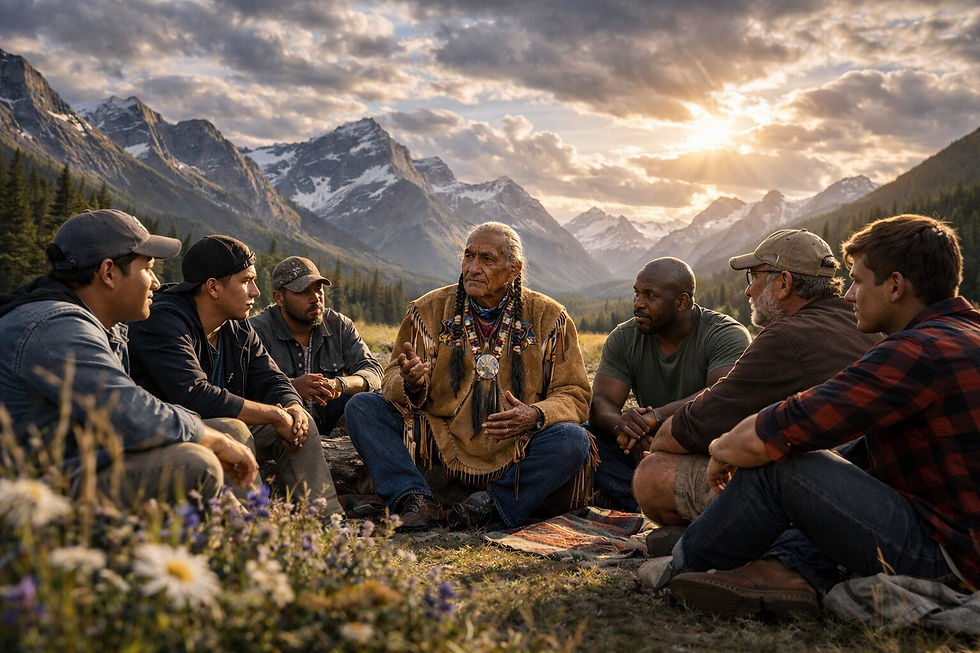
The Call to Brotherhood
Marcus, Kofi, Walter, and Amir each represent a different chapter in the ongoing story of masculine growth. Their journeys remind us that the capacity for intimacy is not fixed at birth but unfolds throughout a lifetime, shaped by the communities we join, the risks we take, and the support we receive.
One of the most powerful discoveries many men make is that vulnerability shared among other men creates its own kind of healing. When Kofi spoke his fears in that basement circle, he discovered that he was not alone. The construction worker, the teacher, the retired engineer, each carried their own version of the struggle. In their presence, Kofi's shame began to dissolve.
Men's organizations across Canada and beyond have recognized this power. They create spaces where men can practice emotional expression, receive feedback, and learn from others who are walking the same path. These spaces challenge the outdated belief that talking about love, vulnerability, and relationships is somehow unmasculine. Instead, they reveal the opposite: that the courage to be tender is itself a mark of strength.
Such communities do not replace intimate partnerships; they complement them. A man who has practiced vulnerability with trusted brothers often finds himself better able to engage in intimacy with a romantic partner. The skills transfer. The confidence builds. The isolation breaks.
If you are reading this and recognizing your own struggle, consider this an invitation. Seek out communities that support men's holistic growth, physical, mental, emotional, and spiritual. These might be men's circles, wilderness retreats, community workshops, or online gatherings. The form matters less than the commitment to showing up authentically.
When you encounter another man who dismisses vulnerability or mocks emotional expression, consider responding not with argument but with modelling. Share your own experience. Demonstrate that strength and openness can coexist. You may plant a seed whose fruit you never see.
Intertwined
Late evening light filters through the window as Marcus and Priya sit together on the couch. The dinner conversation from weeks ago, his admission of fear, and her hand reaching across the table have opened something between them. They talk more now. Not always about heavy things; sometimes just about the texture of their days. But there is a new quality to their connection, a sense that both can be seen.
Marcus still feels fear sometimes. He hasn't been transformed into someone without doubt or insecurity. But he has learned something valuable: that speaking his truth, rather than diminishing him, has deepened his capacity for love. Priya knows him better now. And somehow, being known feels less terrifying than he had imagined.
Across the city, Kofi and Mia walk hand in hand down a downtown street. Last night, he told her about his men's circle, something he had been embarrassed to mention. To his surprise, she was moved.
"I love that you're doing that," she said. "I feel like I'm finally meeting the real you."
The real him. Kofi turns the phrase over in his mind. For most of his life, he had assumed that the real him was something to be hidden. Now he is discovering that the real him, fearful, hopeful, still learning, is exactly who he wants to become.
In a small house outside Edmonton, Walter reaches for Margaret's hand. They are watching the sunset from their porch, as they have done for decades. But now Walter narrates what he sees: the orange light spilling across the fields, the way the birch trees catch the glow, how this moment with her feels like the most precious thing he owns.
Margaret squeezes his hand. "I've always known," she says. "But it's nice to hear."
Walter nods. "I should have said it sooner." "You're saying it now. That's what matters."
The Path Forward
The journey toward intimacy is not linear. There will be moments of opening and moments of retreat, breakthroughs followed by setbacks, conversations that heal and conversations that wound. This is not failure; this is the nature of human growth.
What matters is the direction we face. Toward connection rather than isolation. Toward vulnerability rather than armour. Toward the courage to say, "I'm scared," and the trust that our fears can be held with care.
The research is clear: men who cultivate genuine intimacy live longer, healthier, and more satisfying lives. They are protected against depression, buffered from the ravages of stress, held in webs of relationship that sustain them through difficulty. But beyond the data lies something less measurable and perhaps more important: the quiet joy of being known.
If you take nothing else from these pages, take this: vulnerability is not weakness. It is the doorway to every meaningful connection you will ever have. The risk is real, but so is the reward.
This week, consider taking one small step. Tell your partner something true that you have been holding back. Ask a friend how they're really doing and listen for the honest answer. Seek out a community of men who are walking this same path. Resources exist for those who are ready; men's organizations across Canada offer spaces for exploration, connection, and growth.
You don't have to have it figured out. None of us do. What you need is simply the willingness to begin.
The kitchen light is on. Someone is waiting. Take a breath. Open the door.
Brother, you're right on time.

References
Amin, Shaimaa Mohamed; El-Gazar, Heba Emad; Zoromba, Mohamed Ali; ELfeshawy, Nagwa Ibrahim; Abo-Hatab, Toha Ali ELsayed; El-Sherbini, Hanan Hosni; and Atta, Mohamed Hussein Ramadan. (2025). The Mediating Role of Emotional Intelligence in the Relationship Between Sexual Health Literacy and Sexual Communication Self-Efficacy Among Married Nursing Students. BMC Nursing, 24(1), 653-11, Article 653.
Angus Reid Institute. (2018, May 7). 'I don't': Four-in-Ten Canadian Adults Have Never Married, and Aren't Sure They Want To. Retrieved from https://angusreid.org/marriage-trends-canada/.
Beerepoot, Shanice; Luesken, Suzanne W. M.; Huisman, Martijn; and Deeg, Dorly J. H. (2022). Enjoyment of Sexuality and Longevity in Late Midlife and Older Adults: The Longitudinal Ageing Study Amsterdam. Journal of Applied Gerontology, 41(6), 1615-1624.
Burke, Susan. (2023). Wisdom From the Elders: Kinship Care That Honors Traditional Indigenous Ways. AlterNative: An International Journal of Indigenous Peoples, 19(3), 635-645.
Canadian Men's Health Foundation. (n.d.). Canadian Men's Health Foundation. Retrieved from https://menshealthfoundation.ca/.
Cardus. (2020, June 23; Updated 2025, October). The Canadian Marriage Map. Retrieved from https://www.cardus.ca/research/the-canadian-marriage-map/.
Centre for Addiction and Mental Health [CAMH]. (n.d.). Depression. Centre for Addiction and Mental Health, retrieved from https://www.camh.ca/en/health-info/mental-illness-and-addiction-index/depression.
Family Research Council. (n.d.). Canada First Nations families. The Marriage and Family Encyclopedia, retrieved from https://family.jrank.org/pages/199/Canada-First-Nations-Families.html
Fyfe, Alastair Colin. (2021). Emotional Disclosure: Rethinking the Ways Masculinity Impacts the Willingness to be Vulnerable. San Francisco State University, Master of Science in Psychology Thesis, Clinical Psychology, retrieved from https://scholarworks.calstate.edu/downloads/qb98mm564.
Government of Canada. (2019, November 25). Protective and Risk Factors for Mental Health. Retrieved from https://www.canada.ca/en/public-health/services/protective-risk-factors-mental-health.html.
Health Canada. (2026, February 23). #HealthyMen, The Government of Canada is Launching a National Conversation on Men and Boys' Health. Retrieved from https://www.canada.ca/en/health-canada/news/2026/02/healthymenthe-government-of-canada-is-launching-a-national-conversation-on-men-and-boys-health.html
Manhattan Wellness. (n.d.). How to Get Comfortable with Vulnerability as a Man. Manhattan Wellness, retrieved from https://manhattanwellness.org/how-to-get-comfortable-with-vulnerability-as-a-man/
Mental Health Foundation. (n.d.). Relationships and Community: Statistics. Retrieved from https://www.mentalhealth.org.uk/explore-mental-health/statistics/relationships-community-statistics
Nussbaum, Barry. (2025, October 29). Marriage statistics in Canada. Nussbaum Family Law, retrieved from https://nussbaumlaw.ca/marriage-statistics-in-canada/
Schreiner, Irene. (2025, March 15). Why Sexual Intimacy May Be the Key to a Longer Life. Solid Foundations Therapy, retrieved from https://www.solidfoundationstherapy.com/blogs/why-sexual-intimacy-may-be-the-key-to-a-longer-life
Sigafus, Paul and Rutherford, Ross. (n.d.). Breaking Emotional Barriers: Why Men Struggle to Connect. Colorado Counselling Center, retrieved from https://coloradocounselingcenter.com/breaking-emotional-barriers-men/.
Song, Tiger. (n.d.). The Blackfeet Familial Structure and Lessons for the Modern Day. The Hourglass, retrieved from https://www.lcworldbulletin-hourglass.org/hourglass/the-blackfeet-familial-structure-and-lessons-for-the-modern-day.
Statistics Canada. (2022, March 9). A Fifty-Year Look at Divorces in Canada, 1970 to 2020. Component of Statistics Canada Catalogue No. 11-001-X, The Daily, retrieved from https://www150.statcan.gc.ca/n1/en/daily-quotidien/220309/dq220309a-eng.pdf.
Suri, R. K.; and Srishti, Jain. (2025, June 6). Why Emotional Vulnerability is Harder for Men Than Physical Intimacy. TalktoAngel, retrieved from https://www.talktoangel.com/blog/why-emotional-vulnerability-is-harder-for-men-than-physical-intimacy.
Vella. (2024, December 17). Sex and Longevity. Vella Bioscience, Inc., retrieved from https://vellabio.com/blogs/vella-voice/sex-and-longevity
Weigel, Robert. (2023, July 20). Men and Vulnerability. Vocal Media, retrieved from https://vocal.media/men/men-and-vulnerability.
© Citation:
Pitcher, E. Mark. (2026, March 23). Nurturing Intimacy: Love, Vulnerability, and Emotional Safety in Men's Lives. Beyond Brotherhood. https://www.beyondbrotherhood.ca/post/nurturing-intimacy-love-vulnerability-and-emotional-safety-in-men-s-lives.
About the Author
Mark Pitcher lives where the mountains keep their oldest promises, in a valley in the Canadian Rockies, where glacier-fed waters carve poetry into stone and the night sky burns with a silence so vast it feels like truth speaking. Half the year, he calls this wilderness home, no paved roads, no lights, no noise but the heartbeat of the land. It is here, between two ancient peaks and the hush of untouched forest, that Mark's soul was reforged in the fires of meaning and purpose.
Today, Mark stands as a bridge between two worlds: the untamed wilderness that shapes him and the global brotherhoods that inspire him, WYLDMen, MDI, Connect'd Men, Illuman, Man-Aligned, Sacred Sons, UNcivilized Nation, and The Strenuous Life. He walks among these circles as a brother, a man who has risen with a purpose that hums like thunder beneath his ribs.
His vision is now focused on a singular horizon: the creation of the Beyond Brotherhood Retreat Centre. Mark is currently scouting the rugged landscapes of the Rockies, searching for the specific soil and stone that will hold this sanctuary. This is the next great ascent, a mission to secure a permanent home for men to gather, a place where the land itself becomes the teacher.
Mark's teachings are a constellation of old and new: Viktor Frankl's pursuit of meaning, Indigenous land teachings, the cold bite of resilience training, the quiet medicine of Shinrin-yoku, the flowing strength of Qigong, and the fierce ethics of the warrior who knows compassion is a weapon of liberation. A student of Spiritual Care at St. Stephen's College and a seeker of Indigenous truth and reconciliation at the University of Calgary, he is training to guide others into the healing arms of the forest and cold water.
Mark Pitcher is a man rebuilt in the open, a guide, a mentor, and a storyteller whose voice feels like a compass. He is a wilderness warrior who carries warmth like a fire in the night, a man who says, "You don't have to walk this alone. None of us do." His presence steadies and softens, reminding men of a primal belonging they have long forgotten.
Beyond Brotherhood is the living proof of his promise: a vision shaped by courage and unwavering love, a future sanctuary where men remember who they are, who they were, and who they can still become. Mark's upcoming book will dive even deeper into the rise of wilderness-led masculinity and the return of men to purpose, connection, and meaning.
If your heart is thundering as you read this, that is the signal. That is the call. Mark extends his hand to you with the warmth of a fire in winter: You belong here. Your story belongs here. Your strength belongs here. Walk with him. Into the wilderness. Into the circle. Into the life that's been waiting for you.
The journey is only beginning, and Mark is already at the trailhead, looking back with a smile that says: "Brother, you're right on time."


Comments