

Threads of the Heart: Navigating Masculinity through Fatherhood, Family, and Emotional Connection
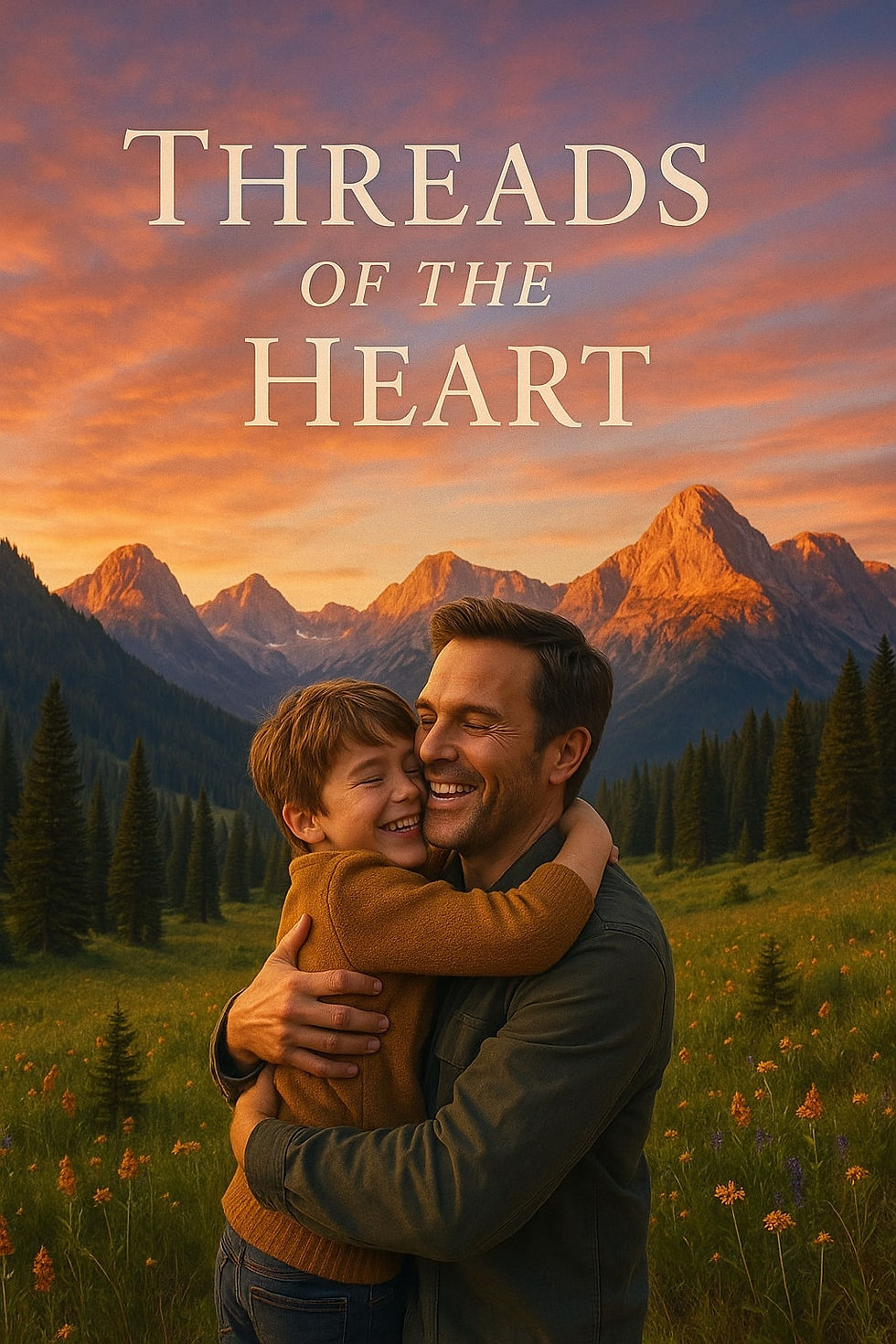
A Perspective on Modern Positive Masculinity
Elliot stood silently in the doorway of his teenage son's room, one hand resting on the chipped white doorframe. It was late, far later than he had intended to be home. His shirt still smelled faintly of printer ink and the sterile tang of late-night paperwork – the sign of another twelve-hour day spent providing for the family he loved so fiercely it made his chest tighten. Noah, Elliot's sixteen-year-old son, sat cross-legged on the bed, headphones clamped over his ears, the distant thrum of bass notes leaking into the quiet hallway.
When Elliot finally spoke, his voice trembled before the words even formed. "Hey, buddy. I missed the game. I'm sorry." He paused, hating how foreign the words felt on his tongue. Apologizing had never been simple. In his own childhood home, apologies had been rare currency. He had learned that real men held steady like anchors – they fixed things and protected others, but they did not show trembling vulnerability.
Noah paused the music and looked up, eyebrows knitting together. "It's okay, Dad. Coach recorded it. You can watch it later if you want."
Elliot felt his breath catch. The boy had shot up another few centimetres this summer, with shoulders spreading and a voice drifting lower every week. Somewhere along the relentless current of time, Elliot realized, he had begun to drift apart from his own son. He had stopped truly swimming beside him. Noah looked up now, seeing not a distant father-figure, but a man standing in the doorway – tired and trying.
"I do want to," Elliot said, pulling the words out slowly. "I want to be there next time. I just… I know I haven't been around as much as I should. I want to do better." His throat clenched, but he pressed on, each syllable unfamiliar yet necessary.
Noah gave a slow, slight nod. In that instant, something shifted. It was not a scene of dramatic reconciliation, but a quiet realization: a boy looking at his father and finally seeing him. Not just "Dad the provider," but Elliot the man – present, imperfect, and trying.
Later that night, after Noah had drifted to sleep with dreams of basketball courts, Elliot sat alone at the kitchen table. His head in his hands, shoulders shaking with silent emotion. The apology had taken only seconds, but inside him it felt as if he had moved a mountain. He wondered why it had taken him so long to give his heart permission to speak.
The truth came slowly. Somewhere on the road to adulthood, Elliot realized, men are often taught to trade tenderness for toughness, to sacrifice emotional connection on the altar of responsibility. Love is measured not by words or presence, but by labour and duty. But in that doorway moment with Noah, Elliot felt something new uncoil in his chest – something warm, frightening, and hopeful. It felt like strength, a different kind of strength—the kind he wanted to pass on.
What the Numbers Reveal About Men, Family, and Well-Being
If fatherhood is a quiet initiation into deeper adulthood, demographic data offer a chorus of confirmation. Canadian research consistently links relational stability and men's health. For example, a recent study using national ageing data found married men were twice as likely to age optimally as never-married men (Canadian Longitudinal Study on Aging [CLSA], 2024). In practical terms, married or partnered men tend to live longer, enjoy better mental health, and report fewer risky behaviours than their single counterparts. The Canadian Longitudinal Study on Aging notes that marriage often encourages couples to support one another in positive habits—such as quitting smoking, exercising, and looking out for one another's well-being (Canadian Longitudinal Study on Aging [CLSA], 2024).
Family remains a cornerstone of identity for Canadian men across all ages. Surveys (though few are public) suggest the vast majority of Canadian men list family as a top life priority. Indeed, even men juggling demanding careers or financial stress care deeply about being there for their children. In provinces that actively encourage paternal caregiving, engagement is rising. In Quebec, for example, the provincial insurance program has driven paternity leave uptake so high that 93% of new fathers took some form of paid parental leave between 2012 and 2017 (Statistics Canada, 2021). (By contrast, only about 24% of fathers outside Quebec did so during that period.) Across Canada, roughly half of all fathers took at least a short leave around their child's birth or adoption, up from just one-third in the early 2000s (Statistics Canada, 2021). These policy shifts reflect a changing culture: more mothers and fathers are sharing early child-rearing, rather than reverting to the old pattern of only mothers taking leave.
The benefits of engaged fatherhood extend to children and mothers as well. Public health research in Canada finds positive father involvement is strongly associated with improved outcomes for children (Public Health Agency of Canada [PHAC], 2022). Children whose fathers are sensitive, playful, and involved score higher on cognitive and emotional tests; they tend to handle stress better and have fewer behavioural problems (Public Health Agency of Canada [PHAC], 2022). In early childhood, calm and attentive fathering boosts infants' mental development, and in school-age years, an involved father correlates with better grades and motivation. Equally striking, mothers of involved fathers benefit too: fathers who engage in pregnancy and childcare can reduce maternal stress and depression and make partners feel more supported in pursuing personal goals (Public Health Agency of Canada [PHAC], 2022).
Fathers themselves gain from connected family life. The Canadian Public Health Agency notes that men with involved parenting roles often see improvements in their own health and lifestyle (Public Health Agency of Canada [PHAC], 2022). Positively involved fathers report better financial stability (likely reflecting two incomes or shared planning), stronger social support networks, and a renewed sense of purpose and meaning. One study even found that expecting and new fathers show hormonal shifts — lower testosterone and higher oxytocin — which may encourage nurturing behaviour and bonding. In short, fatherhood can motivate men to improve their diet, exercise habits, and emotional health (Public Health Agency of Canada [PHAC], 2022). When men step into this role fully, it is not a burden on their well-being; it is a buffer and a booster.
That said, stress is real. Modern fatherhood often means juggling many roles. Canadian "sandwich" caregivers — those simultaneously raising young children and supporting aging parents — report very high levels of strain. A 2024 Statistics Canada analysis found that 86% of sandwich caregivers reported that their responsibilities negatively affected their health or well-being, compared with 62% of those caring for children only (Wray, 2024). Middle-aged parents frequently feel torn between providing, caregiving, and being emotionally present. This generation reports some of the highest stress levels in Canada. In work and society, they often feel pulled: expected to maintain the provider role learned from earlier generations, yet also attend fully to the emotional needs of their children and partners.
Even so, strong family ties can be life-saving. Men who have positive, supportive relationships tend to cope better in crises. Research on suicide prevention shows that men with close family connections have a robust safety net. In Canada, middle-aged men die by suicide at rates nearly three times higher than women, but factors like fatherhood, being a loving husband or partner, and having deep friendships are known to protect men from despair. The Mental Health Commission of Canada stresses that positive, supportive, close relationships with family and friends create a crucial safety net for men (Mental Health Commission of Canada, 2022). In practice, a father who talks openly about struggles, leans on his spouse or brother, and participates in his community builds resilience against the loneliness and pain that, tragically, too often lead men to self-harm.
These data illuminate a powerful truth: family life is not a liability for men—it is a lifeline. Engaged fatherhood and connection bring concrete benefits for men's physical, mental, emotional, and even spiritual well-being. The only catch is that these benefits flourish only when men feel safe to bring their whole selves — emotions and all — into family life.

Rethinking Provider Roles in a New Masculine Landscape
For generations, the "traditional" model of masculinity pictured men primarily as providers, protectors, and problem-solvers. These roles endure in value, but they have often been defined too narrowly. The stern, distant breadwinner-father image was, historically, a relatively recent construct of industrial society, not a timeless norm. In reality, many cultures have long embraced a more relational model of fatherhood. Anthropologists and sociologists note that in numerous Indigenous communities, for example, fathers are storytellers, teachers, and spiritual guides. Children learn traditions from their fathers through song, dance, hunting trips, and simple conversation. In several First Nations traditions, a father's emotional presence and willingness to share his feelings are seen not as weakness, but as a vital duty to the community (Ball, 2010).
Recent Indigenous scholarship echoes this. In one Canadian study, First Nations and Métis fathers spoke of "reconstituting circles of care" – revitalizing cultural strengths disrupted by colonization – and found in fatherhood a source of healing and purpose (Ball, 2010). By reconnecting with ancestral traditions and fully engaging with their children, these men supported secure family bonds and passed on resilience. The research suggests that when men reclaim nurturing roles and express compassion, it counters the historical trauma of paternal absence. In short, for many Indigenous men, fatherhood has always been about more than paying bills; it has been about caring for the whole child and family.
These lessons are not unique to Indigenous cultures. Across societies, fathers who embrace caregiving often report a more integrated sense of self. Fatherhood itself can be a grounding force that softens isolation and adds meaning to men's lives. Engaged fathers in studies often describe feeling "more whole" or "more real" when they connect emotionally with their kids. The work of Cabrera and others shows that men who are involved in daily childcare – whether reading bedtime stories, soothing tears, or celebrating successes – often find that these actions deepen their sense of purpose and identity as men (Cabrera, 2020; Brown et al., 2012; Grossman et al., 2002).
In practical terms, modern fatherhood demands that we expand our repertoire of strengths. A father must still provide and protect, but the currency of provision has widened. Men today are expected – by partners, children, society, and themselves – also to provide availability, warmth, active listening, emotional literacy, and vulnerability. This shift can feel disorienting. A man raised to believe love is proven by sacrifice might feel unprepared when his child or partner asks him to share feelings or sit quietly together. He may wonder how to be both strong and gentle at once, or fear that expressing emotion will look like losing control.
Yet the science is precise: emotional connection is strength refined, not strength diminished. Neuroscience and attachment research show that children thrive when parents are attuned to their emotions. Morris et al. review decades of work on emotion regulation and conclude that "children learn about emotion regulation through observational learning and modelling" by parents, and from the overall emotional climate at home (Morris et al., 2007). In other words, a father who names his own challenges, listens to his child's fears, or even sheds a quiet tear teaches resilience. He normalizes struggle and coping, rather than leaving a child to face anxieties alone.
Many men's organizations emphasize that a whole man includes his physical, mental, emotional, and spiritual health in balance – that tenderness and toughness can coexist. Vulnerability does not erode manhood; it channels strength toward connection. A man who can say "I'm here" or "I felt that too" directs his energy toward compassion, which, in turn, stabilizes his inner foundation.
Thus, embracing fatherhood and family life does not erode masculinity. It evolves it. It invites men to be both pillars and poets, both protectors and poets of feeling. It requires strength, but a nuanced strength that includes courage to express love and fear. In the new masculine landscape, a good father is not merely the one who works all day; it is the one who also cooks dinner, reads bedtime stories, comforts sadness, and apologizes when wrong. In doing so, he does not lose manhood—he redefines it.

Everyday Rituals for Emotional Presence
Philosophy matters little without practice. Emotional presence is not a rare talent; it is a skill honed by habit. Simple rituals can weave connection into daily life, helping fathers grow emotionally fluent. These practices embody the integrated well-being that most men's organizations champion, nourishing men's physical, mental, emotional, and spiritual sides simultaneously.
One powerful practice is an Emotion-Sharing Circle. Once a week, the family gathers in a relaxed space – around the dinner table, on the porch at sunset, or even around a backyard fire. Each person, including Dad, takes turns naming one "rose" (something positive) and one "thorn" (something challenging) from the past week. When a father says aloud, "My rose this week was fixing the shed with Noah, my thorn was feeling overwhelmed at work," he models honesty and acceptance of difficulty. Research on family emotion supports this: children learn to regulate feelings not just from direct teaching but also from watching parents process emotions openly (Morris et al., 2007). By sharing his own struggles, a father teaches his child that having "thorns" is normal – not shameful – and that talking about them makes them smaller.
Another ritual is the Listening Date. Carve out just ten minutes a day – no phones, no agendas. Sit with your partner or with each child, and listen. Let them speak about whatever they choose: school, friends, worries. Resist the urge to problem-solve unless asked; instead, show compassion: nod, reflect, ask gentle questions. Although 10 minutes may seem small, it signals to loved ones that their thoughts matter. The payoff is big: couples who practice active listening and compassion report significantly higher relationship satisfaction and lower conflict (Gardenswartz, 2024). When fathers participate fully in these conversations, they build trust and reduce misunderstanding. Over time, even short daily check-ins deepen intimacy and model respectful communication for children.
Shared adventure is another thread of connection. Plan a monthly Adventure Day with your child (or children): a hike in the woods, a bike ride by the river, a backyard camp-out with a fire and bannock, or building a birdhouse together. The goal isn't the destination but the shared experience. Physical activities engage the body and mind in low-pressure conversation, which many find easier than face-to-face sit-down talks. Play and movement release endorphins and reduce stress, making it easier to open up naturally. Research on father–child play shows that joint physical activities strengthen bonds and boost children's confidence and emotional growth (Public Health Agency of Canada [PHAC], 2022). Whether skipping stones or shooting hoops, these adventures remind both father and child that they are on the same team, facing life together.
At family meals, try the Rose–Thorn Ritual. Similar to the weekly circle but scaled to daily life, it encourages each person at the table to share one positive (a rose) and one challenge (a thorn) from the day. By having fathers confess their own thorns – perhaps "I'm worried about deadlines at work" – they normalize discussing worries. This simple habit aligns with family-emotion research, which finds that children absorb family patterns of dealing with stress (Morris et al., 2007). When a father admits his difficulties, he sends the message that admitting vulnerability is not a sign of defeat. Gradually, kids learn that talking through anxiety or disappointment is part of life, not something to hide.
Finally, consider a brief Legacy Reflection or meditation before bed. Quietly reflect on or journal about the kind of memory you hope to leave your children. Ask yourself: What values do I want them to feel in their heart when they remember me? Writing a sentence or two can crystallize purpose and reduce anxiety. Decades of research by Pennebaker and others show that journaling about meaningful topics improves emotional clarity and can lower stress (Statistics Canada, 2021; Pennebaker and Smyth, 2016). Even if just a mental note, this ritual connects daily actions to deeper intentions. It reminds a father that every bedtime story, every apology, and every question about a child's day weaves into his legacy.
These practices don't erase the pressures on modern fathers. Men still face long hours, financial stress, and cultural expectations. But rituals like these create touchpoints of connection amid the bustle. They build muscle memory for tenderness. Over time, a father who consistently shows up emotionally – even in small ways – finds that his inner calm grows. His children become more confident, his partner feels more loved, and he discovers that his own well-being improves alongside theirs.

A Call to Brotherhood: Learning and Growing Together
No man is an island, and this is especially true for those charting new territory in masculinity. One of the strongest protective factors for men's mental health is brotherhood – the circle of friends and peers who understand men's unique challenges. Solid friendships and support networks significantly lower men's rates of depression, anxiety, and substance misuse (MacKenzie et al., 2018). Yet too often, men drift into isolation as responsibilities pile up. Work, family duties, and pride can keep them from reaching out when they need support.
Breaking this cycle takes intention. Some fathers find unexpected mentors: a seasoned dad at work offering advice to a rookie parent, or an uncle sharing stories about juggling life and kids. Others join fatherhood groups, cultural community events, or men's circles focused on personal growth. The key is openness. A father might confide, "I feel guilty for missing Noah's games, but I'm also stressed about paying the bills," or express, "I panicked when Ella was sick – I realized I'm terrified of losing someone I love." Sharing these real feelings with other dads in a group can be profoundly healing.
Research of men's groups – including community-led programs with Indigenous elders – shows that talking openly about fatherhood can be revolutionary. In Indigenous healing groups, discussions of fatherhood become sites of cultural reconnection and empowerment. Men support each other in reclaiming positive masculine roles that colonization tried to erase. Internationally, studies find similar dynamics: men who build communities around fatherhood learn from each other's successes and failures. They create a training ground for emotional courage. A man who hears a peer talk about fear, joy, or doubt is often relieved to find he is not alone. Witnessing others speak honestly about their struggles permits one to do the same.
Many men's organizations emphasize that no man should navigate life alone. When fathers share stories, seek guidance, and listen to one another, they multiply their strength. Each father becomes both student and teacher in this brotherhood. When a man receives support, he carries it home. A supported father shows up more fully; a present father raises children who feel loved and safe; those children grow into adults who will one day carry compassion into their own families. It is literally a generational transformation at work.
The Quiet Legacy of Loving Men
Picture a multi-generational shoreline at dusk. A grandfather stands knee-deep in a silver-lit river, steadying the fishing line of his grandson. Nearby, a father crouches beside his young daughter, teaching her to skip stones across a calm bend. The air smells of cedar and damp earth. Laughter and quiet talk rise like birds from the reeds.
This scene isn't nostalgia; it's the present reframing what masculinity can be. Masculinity isn't defined by hardness or isolation, but by the threads we weave and pass down. What fathers pass on is not wealth or titles, but wisdom, kindness, and courage. A father's legacy lives on in every "I'm here" whispered in the dark, every gentle pat on the shoulder that says "I'm listening," every story told by the campfire.
The world often measures a man's worth by production and stoicism. But children measure love in presence, partners measure intimacy in attentiveness, and the soul measures purpose in connection. Tomorrow, choose one small act that honours this truth. Read that bedtime story you put off. Text your dad or grandfather a grateful note. Walk the dog with your son or sit quietly with your daughter and ask what's on her mind. Say the apology you owe your friend. Or lay a hand on someone's shoulder and say, "I'm here."
Strength is not diminished by gentleness – it is defined by it. These threads of the heart – woven through fatherhood, family, and emotional connection – form the fabric of a masculinity that is at once modern and timeless. A masculinity that heals. A masculinity that leads. A masculinity that loves.

References
Allen, Sarah; and Daly, Kerry. (2012). Fathers Make a Difference in Their Children's Lives: A Review of the Research Evidence. In J. Ball, Jessica and Daly, Kerry (Eds.), Father Involvement in Canada: Diversity, Renewal and Transformation. UBC Press, ISBN 9780774824019.
Ball, Jessica. (2010). Indigenous Fathers' Involvement in Reconstituting "Circles of Care". American Journal of Community Psychology, 45(1–2), 124–138.
Brown, Geoffrey L.; Mangelsdorf, Sarah C.; and Neff, Cynthia. (2012). Father Involvement, Paternal Sensitivity, and Father-Child Attachment Security in the First Three Years. Journal of Family Psychology, 26(3), 421-430.
Cabrera, Natasha J. (2020). Father Involvement, Father-Child Relationship, and Attachment in the Early Years. Attachment and Human Development, 22(1), 134-138.
Canadian Longitudinal Study on Aging [CLSA]. (2024, October 29). Marriage Strongly Associated with Optimal Health and Well-Being in Men as They Age. EurekAlert! University of Toronto, retrieved from https://www.clsa-elcv.ca/marriage-strongly-associated-with-optimal-health-and-well-being-in-men-as-they-age/.
Gardenswartz, Cara. (2024, July 30). The Art of Listening: Improve Communication with Your Partner. Enhance Your Relationship with Simple, Effective Communication Techniques. Psychology Today, retrieved from https://www.psychologytoday.com/us/blog/the-discomfort-zone/202407/the-art-of-listening-improve-communication-with-your-partner.
Grossmann, Karin; Grossmann, Klaus E.; Fremmer-Bombik, Elisabeth; Kindler, Heinz; Scheuerer-Englisch, Hermann; and Zimmermann, Peter. (2002). The Uniqueness of the Child-Father Attachment Relationship: Fathers' Sensitive and Challenging Play as a Pivotal Variable in a 16-year Longitudinal Study. Social Development, 11(3), 301-337.
McKenzie, Sarah K.; Collings, Sunny; Jenkin, Gabrielle; and River, Jo. (2018). Masculinity, Social Connectedness, and Mental Health: Men's Diverse Patterns of Practice. American Journal of Men's Health, 12(5), 1247-1261.
Mental Health Commission of Canada. (2022, March 30). Men and Suicide Fact Sheet. Retrieved from https://mentalhealthcommission.ca/fact-sheets/prevention/men-and-suicide
Morris, Amanda Sheffield; Silk, Jennifer S.; Steinberg, Laurence; Myers, Sonya S.; and Robinson, Lara Rachel. (2007). The Role of the Family Context in the Development of Emotion Regulation. Social Development, 16(2), 361-388.
Pennebaker, James W.; and Smyth, Joshua M. (2016). Opening Up by Writing It Down: How Expressive Writing Improves Health and Eases Emotional Pain (3rd Ed). Guilford Publications, ISBN 9781462524921.
Public Health Agency of Canada [PHAC]. (2022, June 20). Benefits of Father Involvement. Retrieved from https://www.canada.ca/en/public-health/services/publications/healthy-living/benefits-father-involvement.html.
Reis, Harry; and Gable, Shelly L. (2015). Responsiveness. Current Opinion in Psychology, 1, 67–71.
Statistics Canada. (2021, February 10). Family Matters: Parental Leave in Canada. The Daily, retrieved from https://www150.statcan.gc.ca/n1/daily-quotidien/210210/dq210210a-eng.pdf.
Statistics Canada. (2023, August 15). Statistical Checkup of Canadian Men's Health. Retrieved from https://www.statcan.gc.ca/o1/en/plus/6413-statistical-checkup-canadian-mens-health.
Wray, Dana. (2024, April 2). "Sandwiched" Between Unpaid Care for Children and Care-Dependent Adults: A Gender-Based Study. Statistics Canada, retrieved from https://www150.statcan.gc.ca/n1/pub/89-652-x/89-652-x2024002-eng.htm.
© Citation:
Pitcher, E. Mark. (2025, December 15). Threads of the Heart: Navigating Masculinity through Fatherhood, Family, and Emotional Connection. Beyond Brotherhood. https://www.beyondbrotherhood.ca/post/threads-of-the-heart-navigating-masculinity-through-fatherhood-family-and-emotional-connection
About the Author
Mark Pitcher lives where the mountains keep their oldest promises—in a valley deep in the Canadian Rockies, where glacier-fed waters carve poetry into stone and night skies burn with a silence so vast it feels like truth speaking.
Half the year, he calls this wilderness home—no paved roads. No lights. No noise but the heartbeat of the land.It is here—between two ancient peaks, in the hush of untouched forest—that Mark's soul was reforged in the fires of loss and meaning.
Because his journey did not begin with peace, it started with a crack in the universe.
On January 3, 2024, when his beloved Maggie left this world, Mark stood at the edge of unthinkable heartbreak. And in that devastating stillness, he offered a vow to the sky: "Find community. Find purpose."
Those words didn't just echo—they opened something. Something fierce. Something ancient. Something that refused to let him sink into the dark.
From that vow, the first spark of Beyond Brotherhood leapt to life—a spark that would become a fire strong enough to warm other grieving souls, lost souls, searching souls, warrior souls who had forgotten the sound of their own heartbeat. Mark walked into his sorrow and came out carrying a torch.
Today, he stands as a bridge between two worlds: the untamed wilderness that shapes him, and the global brotherhoods that inspire him—WYLDMen, MDI, Connect'd Men, Illuman, Man-Aligned, Sacred Sons, UNcivilized Nation, and The Strenuous Life.
He walks among these circles as a brother beside—a man who has knelt in the ashes and risen with a purpose that hums like thunder beneath his ribs.
Mark's teachings are a constellation of old and new: Viktor Frankl's pursuit of meaning, Indigenous land teachings, the cold bite of resilience training, the quiet medicine of Shinrin-yoku, the flowing strength of Qigong, the psychology of modern brotherhood, and the fierce ethics of the warrior who knows compassion is a weapon of liberation.
He is a student of Spiritual Care at St. Stephen's College, a seeker of Indigenous truth and reconciliation at the University of Calgary. He is training to guide others into the healing arms of the forest and cold water.
But titles barely touch him. Mark Pitcher is a man rebuilt in the open—a man who lets grief speak so others can let their truth breathe. A guide. A mentor. A storyteller whose voice feels like a compass. A wilderness warrior who carries warmth like a fire in the night. A man who says, "You don't have to walk this alone. None of us does."
His presence does something to people—it steadies them, softens them, reminds them of a primal belonging they have long forgotten.
Beyond Brotherhood is the living proof of his promise: a sanctuary shaped by grief, courage, and unwavering love—a place where men remember who they are, who they were and who they can still become.
Mark's upcoming book will dive even deeper into the rise of wilderness-led masculinity—the rebirth of brotherhood in a fractured world, the return of men to purpose, connection, and meaning.
And if your heart is thundering as you read this—good.
That's the signal.
That's the call.
Mark extends his hand to you with the warmth of a fire in winter: You belong here.
Your story belongs here. Your strength belongs here. Walk with him. Into the wilderness. Into the circle. Into the life that's been waiting for you.
The journey is only beginning—and Mark is already at the trailhead, looking back with a smile that says: "Brother, you're right on time."


Comments