

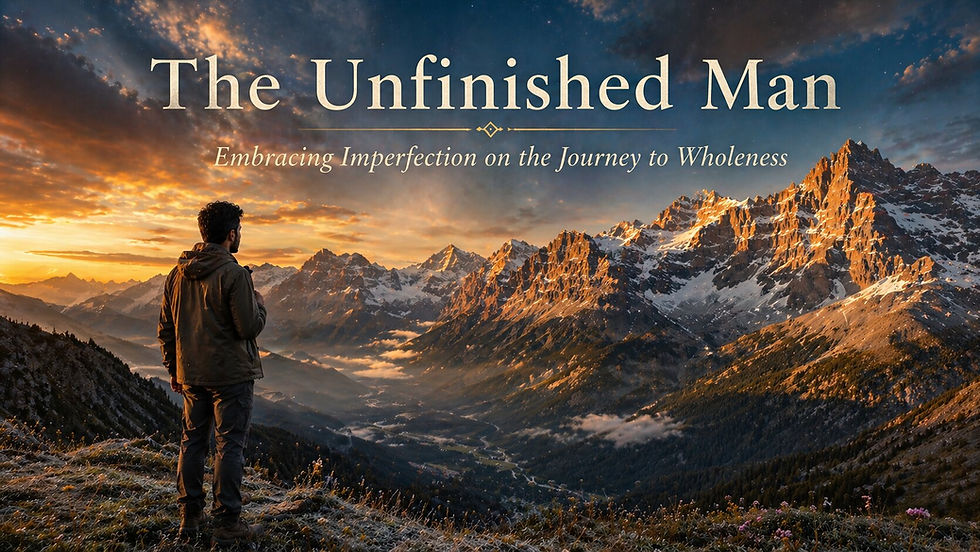
The Unfinished Man: Embracing Imperfection on the Journey to Wholeness
"I have spent my whole life trying to be perfect. I am exhausted."
Jonathan, 42, surgeon and father of two
The fluorescent lights of the hospital corridor had been Jonathan's sky for the better part of two decades. At forty-two, he moved through surgical suites with the fluid certainty of a man who had mastered his craft, steady hands, a decisive mind, a reputation built on precision. His colleagues called him brilliant. His patients trusted him with their lives. His mother still introduced him at gatherings as "my son, the surgeon," her voice bright with a pride that, to Jonathan, felt like a weight he could never set down.
What nobody saw was the 3:00 am insomnia, the way his mind replayed every procedure, searching for the error that might be hiding in the margins. They did not see his wife's quiet withdrawal after years of competing with his relentless self-improvement for a sliver of his attention. They did not know about the antacids he chewed like candy, or the way his jaw ached from clenching through the night, or the creeping suspicion that if anyone truly knew him, really knew him, they would discover what he had always feared: that he was not enough.
It was at a men's retreat in the foothills of the Canadian Rockies that something cracked open. Not a surgical complication. Not a diagnostic failure. Something far more terrifying. The facilitator had asked each man to share something "unfinished" about himself. Jonathan had planned to offer something manageable, a hobby he had been meaning to pick up, a fitness goal left incomplete. But when his turn came, the words that left his mouth were not the ones he had rehearsed. "I have spent my whole life trying to be perfect," he said, his voice breaking like a river over stones. "And I am exhausted."
The room held him. No one rushed to fix him. No one offered advice. A retired teacher from Winnipeg placed a hand on his shoulder. A young Cree tradesperson across the circle nodded slowly, his own eyes glistening. In that silence, that sacred, unhurried silence, Jonathan felt something he had not felt in years: permission to be incomplete.
The Quiet Epidemic: Perfectionism and the Modern Man
Jonathan's story is not unusual. It is, in fact, quietly epidemic. Across Canada and much of the Western world, perfectionism is rising at an alarming pace, according to researchers. A landmark meta-analysis by Thomas Curran and Andrew Hill (2019), examining over 41,000 university students in Canada, the United States, and the United Kingdom between 1989 and 2016, found that self-oriented perfectionism increased by 10 percent, other-oriented perfectionism by 16 percent, and socially prescribed perfectionism, the belief that others demand perfection from us, by a staggering 33 percent. These are not small shifts. They represent a generational transformation in how young people relate to themselves and the world.
The Canadian context adds urgency to these numbers. Research from the Canadian Men's Health Foundation (2025) reveals that 64 percent of Canadian men report moderate-to-high levels of stress. This figure rose by 4 percentage points in a single year. Nearly one in four men is at risk of moderate-to-severe depression, and among young men aged 19 to 29, the numbers are devastating: 43 percent face that risk, alongside 57 percent experiencing moderate-to-high anxiety (Canadian Men's Health Foundation, 2024). These are not abstract statistics. They are brothers, sons, fathers, and friends who are quietly drowning in expectations they cannot meet.
Paul Hewitt and Gordon Flett, pioneering Canadian researchers at the University of British Columbia and York University, respectively, have spent decades mapping the architecture of perfectionism. Their work established that perfectionism is not merely a desire to do well; it is a multidimensional personality construct with self-oriented, other-oriented, and socially prescribed dimensions, each capable of generating distinct forms of psychological suffering (Hewitt & Flett, 1991). Their Perfectionism Social Disconnection Model reveals something particularly poignant: perfectionists attempt to connect with others by appearing flawless, but this very behaviour creates distance and alienation, the opposite of what they crave (Hewitt & Flett, 1991). The man who works hardest to seem perfect often becomes the loneliest man in the room.
For men specifically, perfectionism frequently manifests as performance-based self-worth, the deeply held belief that one's value as a human being is contingent upon achievement, productivity, and the avoidance of failure. Jennifer Crocker and Connie Wolfe (2001) demonstrated that when self-esteem is staked on performance, every setback becomes an existential threat. A missed promotion is not a career disappointment; it is proof of fundamental inadequacy. A strained marriage is not a challenge to relationships; it is evidence of personal failure. The stakes are never merely professional or personal; they are ontological. They touch on the very question of whether one deserves to exist.
The Architecture of Shame: How Men Learn to Hide
Beneath perfectionism lies its silent architect: shame. Brené Brown, whose research involved over 1,280 participants, including 530 men, defines shame as "the intensely painful feeling or experience of believing that we are flawed and therefore unworthy of love, belonging, and connection" (Brown, 2012, p. 69). Her work revealed a finding that should give every man pause: while women experience shame as a web of competing and contradictory expectations, men experience it through a single, devastating lens, "Do not be perceived as weak" (Brown, 2012). One rule. One imperative. And it governs everything.
Consider Marcus, a 67-year-old Jamaican-Canadian grandfather in Scarborough who spent forty years as a construction foreman. He built apartment towers and shopping centres. He provided for three children and helped raise five grandchildren. But when his knees gave out, and he could no longer work, he spiralled into a depression he could not name. "I was the man who built things," he told a community counsellor. "Without that, what am I?" Marcus had fused his identity so completely with his capacity to perform that retirement felt not like rest but like erasure.
Shame, Brown's research shows, thrives in three conditions: secrecy, silence, and judgment (Brown, 2012). For men conditioned to equate vulnerability with weakness, these conditions describe the interior landscape of daily life. A 2024 study reported that 67 percent of Canadian men have never accessed professional mental health services (Canadian Men's Health Foundation, 2025). Not because services do not exist, but because asking for help triggers the very shame these men are trying to escape. It is a closed loop, a psychological trap disguised as strength.
The consequences ripple outward. In Canada, men account for approximately 75 percent of the estimated 4,400 suicide deaths annually (Public Health Agency of Canada, 2025). This figure is not merely a health statistic; it is a measure of silence. It tells us that thousands of men each year reach a point where the pain of imperfection, of not measuring up, of being seen as weak or broken, becomes unbearable. And it tells us that our culture's definition of masculine strength is, quite literally, killing the men it claims to serve.
The Angus Reid Institute (2019) found that 23 percent of Canadians fall into the "Desolate" category, which includes both loneliness and social isolation. Half of all Canadian men are at risk of social isolation, with the figure rising to 67 percent among young men aged 19 to 29 (Canadian Men's Health Foundation, 2025). Perfectionism and shame do not merely damage individuals; they sever the connections that sustain communities.

Where Perfection Takes Root: The Soil of Conditioning
Perfectionism does not emerge from nowhere. It is planted in childhood, watered by culture, and pruned into shape by the relentless messaging of a hyper-competitive society. Many men can trace their roots to specific moments: a father who showed approval only after a winning goal, a school system that ranked worth by grade-point averages. This culture celebrated the "self-made man" while erasing the community that made him possible.
Curran and Hill (2019) identify neoliberal governance, with its emphasis on competitive individualism and market-based meritocracy, as a primary driver of rising perfectionism among younger generations. In a culture that tells men their value is determined by what they produce, consume, and achieve, imperfection is not merely undesirable; it is existentially threatening. The gap between high school seniors who expect to earn a university degree and those who do has doubled since 1976, creating a chasm between aspiration and reality that perfectionism rushes to fill (Curran & Hill, 2019).
Social media amplifies this dynamic with ruthless efficiency. The curated lives that scroll past on screens present an endless gallery of men who appear to have it all: the career, the body, the relationship, the purpose. For those already predisposed to perfectionism, this digital comparison trap can be devastating. The American Psychological Association has noted that social media promotes "crafted, perfect lives" that are fundamentally unrealistic, yet serve as the unconscious standard against which men measure themselves (American Psychological Association, 2023).
Amir, a 23-year-old Pakistani-Canadian university student in Edmonton, described the experience with painful clarity. "I look at my phone, and everyone is doing something amazing and starting companies, travelling the world, getting engaged. And I am sitting in my apartment eating instant noodles and failing organic chemistry. I know it is not real, but it does not matter. It feels real. And I feel like I am falling behind everyone." Amir's perfectionism had metastasized into paralysis; he was so afraid of producing imperfect work that he had stopped submitting assignments altogether, creating the very failure he was trying to prevent.
The Wisdom of Wholeness: What Ancient Traditions Already Know
The tyranny of perfectionism is, in many ways, a modern affliction, one that ancient wisdom traditions anticipated and addressed long before psychology gave it a name. Indigenous teachings across Turtle Island offer a particularly powerful counter-narrative, one rooted not in the pursuit of flawlessness but in the embrace of wholeness.
The Medicine Wheel, a sacred symbol in many First Nations cultures, represents the interconnectedness of all aspects of life through four directions, each associated with a season, a stage of life, and a dimension of well-being: physical, emotional, mental, and spiritual (Wenger-Nabigon, 2010). What is remarkable about this framework is what it lacks: there is no direction toward "perfection." The teaching is not about arriving at a state of flawlessness but about maintaining balance among four ever-shifting dimensions. The East brings new beginnings and vision; the South, growth and nurturance; the West, introspection and emotional depth; the North, wisdom and rest. Each direction is necessary. None is sufficient alone. And the centre, the fire within, represents the self in continuous, unfinished relationship with everything around it (Manitowabi, 2018).
Richard Katz, a Harvard-trained psychologist and professor emeritus at the First Nations University of Canada, argues that Western psychology has much to learn from Indigenous healing approaches. Indigenous healing, he writes, views the individual as intricately connected to family, community, and the natural world, and understands that healing requires addressing all four domains simultaneously (Katz, 2017). This is a direct challenge to the perfectionist's compartmentalized approach: the surgeon who perfects his professional life while his emotional and relational lives wither; the young entrepreneur who optimizes his body while his spirit starves.
The DUDES Club, an Indigenous-led men's wellness initiative in British Columbia, offers a living example of these principles. Research by Efimoff and colleagues (2021) found that the program improved the health and well-being of both Indigenous and non-Indigenous men by fostering connections and creating a "brotherhood" where strength emerged through vulnerability and honest conversation (Efimoff et al., 2021). The DUDES Club does not demand that men arrive polished and complete. It asks only that they arrive.
Buddhist traditions echo this understanding. Pema Chodron (2001), the renowned Buddhist teacher, writes that suffering often stems not from our circumstances but from our relationship to them, specifically, from our insistence that reality conform to our expectations of how things "should" be. The practice she advocates is not self-improvement but self-befriending: learning to sit with discomfort, to make peace with groundlessness, to discover that impermanence and imperfection are not obstacles to a meaningful life but its very texture.
The Japanese philosophy of kintsugi, the art of repairing broken pottery with gold lacquer to illuminate rather than conceal the cracks, offers a visual metaphor that resonates deeply with the journey of the unfinished man (Xie, 2025). A kintsugi bowl does not pretend it was never broken. It wears its history openly, and in doing so, becomes more beautiful and more valuable than it was before the fracture. What if men could learn to see their own fractures this way, not as evidence of failure but as seams of gold running through a life fully lived?
Richard Rohr (2011), the Franciscan priest and author, captures this insight in his concept of "falling upward." Rohr argues that the first half of life is necessarily spent building a container, identity, career, security, but that the second half demands something entirely different: the courage to discover what the container was meant to hold. This falling upward is triggered not by success but by failure, loss, and the humbling recognition that one's carefully constructed self is not the whole story. "The greatest enemy of ordinary daily goodness and joy," Rohr writes, "is not imperfection, but the demand for some supposed perfection" (Rohr, 2011, p. 63).
The Antidote Within: Self-Compassion and the Courage to Be Kind
If shame is the engine of perfectionism, self-compassion is the hand that reaches for the ignition and turns it off. Kristin Neff, the psychologist who first operationally defined and measured self-compassion, describes it as comprising three interrelated components: mindfulness (acknowledging suffering without being consumed by it), common humanity (recognizing that imperfection is a shared human experience, not an individual failing), and self-kindness (extending to oneself the same warmth one would offer a struggling friend) (Neff, 2011).
The research evidence is robust and growing. Neff's Self-Compassion Scale, validated across diverse populations, consistently shows that higher self-compassion predicts greater happiness, optimism, and life satisfaction, as well as lower levels of depression, anxiety, stress, rumination, perfectionism, and body shame (Neff, 2023). Critically, self-compassion achieves many of the benefits of high self-esteem, a stable sense of worth, and resilience in the face of setbacks, without its pitfalls. Unlike self-esteem, which often depends on outperforming others or maintaining a positive self-image, self-compassion provides a sense of worth that is not contingent on performance (Neff, 2011).
For men, this distinction is not academic; it is lifesaving. Research on gender differences in self-compassion reveals that men report slightly higher levels than women overall, with a small effect size (Yarnell et al., 2015). But these findings mask a crucial nuance: men who adhere most rigidly to traditional masculine norms, emotional restrictiveness, stoicism, and self-reliance, show significantly lower self-compassion (Yarnell et al., 2015). In other words, the men who need self-compassion most are precisely the men least likely to practise it. The masculine code that says "never show weakness" blocks the very path to healing.
Here is something worth pausing for. Place your hand on your chest and notice your breathing for a moment. Feel the rise and fall. Now say quietly to yourself: "This is a moment of suffering. Many men feel this way. May I be kind to myself?" These three phrases, drawn from Neff's (2011) self-compassion framework, are deceptively simple. The first cultivates mindfulness: it names the pain without fleeing from it. The second invokes common humanity: it reminds us that struggling does not make us defective; it makes us human. The third extends self-kindness: it offers the tenderness we so freely give to others but so rarely direct inward. This is not a one-time exercise. It is practice. Like building muscle, it requires repetition. Try it tonight when the inner critic begins its familiar monologue. Try it tomorrow morning before the day's demands crowd out your awareness of your own humanity.
Jon Kabat-Zinn's (1990) foundational work on mindfulness-based stress reduction underscores the mechanism at work here. Mindfulness does not eliminate suffering; it changes one's relationship to it. Instead of being swept away by the current of self-criticism, mindfulness offers a vantage point, a rock in the river from which one can observe the water's force without being carried downstream. For the perfectionist, this is revolutionary. It means that the thought "I am not enough" can be noticed, acknowledged, and released rather than accepted as an irrefutable truth.

Gold in the Fractures: Reframing Failure as Foundation
If perfectionism teaches men to hide their cracks, the journey toward wholeness requires learning to see them differently. Consider this exercise, drawn from the intersection of cognitive-behavioural practice and the kintsugi philosophy of illuminated repair. Take a piece of paper and write down five perceived failures, moments where you believe you fell short. They might be professional (a career pivot that did not pan out), relational (a marriage that ended), physical (a body that no longer performs as it once did), or personal (a promise to yourself that you did not keep).
Now, besides each one, write two things: "What I learned from this" and "How this shaped me positively." Be specific. Be honest. The failed business taught you humility and the limits of control. The ended marriage revealed the ways you were hiding from intimacy. The injury forced you to discover patience and ask for help, perhaps for the first time.
This is not positive thinking. It is not pretending that failure does not hurt. It is the hard-won, gold-seamed recognition that failure is not an endpoint. It is a pathway. Every man carries fractures. The question is not whether you have been broken but what you choose to fill the cracks with: shame or gold.
Marcus, the retired foreman from Scarborough, eventually found his gold. Through a neighbourhood men's group at his local community centre, he began volunteering as a mentor for young men entering the trades. "I cannot swing a hammer anymore," he said. "But I can tell a young man what I wish someone had told me at his age: your worth is not in what you build. It is in who you are when the tools are put away." His perceived failure, the body that could no longer perform, became the very foundation of a new purpose.
Good Enough Is Good Enough: Interrupting the Inner Critic
Perfectionism has a voice. It is the voice that whispers, "One more revision" at midnight. It says, "You should be further along by now," while you sit in traffic. It insists, "Everyone else has it together; why can't you?" as you lie awake in the dark. Learning to interrupt this voice is not a luxury; it is a survival skill.
The psychologist Donald Winnicott introduced the concept of the "good enough" parent decades ago, recognizing that perfection in caregiving is neither achievable nor desirable, that children need their parents to be imperfect so they can learn to navigate an imperfect world. The same principle applies to the self. A "good enough" life is not a diminished life. It is a life freed from the paralyzing demand that every moment, every effort, every relationship must be flawless.
Try this. The next time you feel the familiar tightening of perfectionism, the clenched jaw, the restless need to revise, the critical inner voice that says, "not yet, not good enough", pause. Take a breath. And say to yourself: "Good enough is good enough. I am not my performance. I am worthy as I am." Repeat it until you feel the grip loosen, even slightly. This is not self-delusion. It is an act of defiance against a culture that profits from your self-doubt.
Amir, the university student in Edmonton, discovered this mantra through an unexpected source, a podcast about men's mental health that a friend shared over text. "I used to think that if I was not perfect, there was no point in trying," he said. "Now I say, 'Good enough is good enough,' before I submit an assignment. It is not magic. I still get anxious. But the paralysis is mostly gone. I can move again." Amir's grades improved, but more importantly, so did his relationship with himself. He began attending a peer support circle at his university, discovering that nearly every man in the room shared the very imperfections he had been hiding.

Breaking the Silence: When Men Speak, Shame Loses Its Power
Shame thrives in secrecy. This is perhaps its most essential characteristic and its most exploitable weakness. When men speak their imperfections aloud, in a circle, to a friend, even in a whisper to the open sky, shame begins to dissolve. Not immediately. Not completely. But perceptibly, like frost yielding to the first warmth of morning.
Brown's (2012) Shame Resilience Theory identifies four elements that build resistance to shame: recognizing shame and understanding its triggers; practising critical awareness of the unrealistic expectations that fuel it; reaching out to others; and speaking about shame itself. The common thread is connection. Empathy, Brown writes, creates a "hostile environment for shame." When a man shares his story and is met not with judgment but with recognition, when another man says, "I have felt that too", the shame that seemed permanent reveals itself as soluble.
Men's circles and community support groups provide structured spaces where this alchemy can occur. Research on initiatives such as the DUDES Club has demonstrated measurable improvements in health outcomes and well-being when men are given regular access to spaces for brotherhood and honest conversation (Efimoff et al., 2021). The Movember Foundation's work on peer support in recovery echoes these findings, suggesting that men's mental health improves most dramatically not through individual intervention alone but through sustained relational connection (Movember Foundation, 2020).
What happens in these spaces is subtle but profound. A man enters carrying the weight of an image he has maintained for decades, the provider, the stoic, the rock. He sits in a circle and hears another man describe the same weight. He realizes, perhaps for the first time, that he is not uniquely broken. He is universally human. And in that realization, something shifts. The weight does not vanish, but it becomes shareable. It becomes lighter. This is the power of common humanity, not as an abstract concept but as a lived, felt, embodied experience.
The importance of this relational healing cannot be overstated. Statistics Canada data confirm that men who report always or often having someone to count on are significantly more likely to rate their mental health as excellent or very good (55 percent) compared to those who sometimes, rarely, or never have such support (38 percent) (Statistics Canada, 2023). Connection is not merely pleasant; it is physiologically protective. It changes the body's chemistry, the brain's architecture, and the trajectory of life.

The Unfinished Man in Four Dimensions: Body, Mind, Heart, and Spirit
Wholeness is not a destination. It is a practice that engages every dimension of a man's being, physical, mental, emotional, and spiritual. The perfectionist tends to over-develop one domain at the expense of the others: the executive who hones his mind while his body atrophies, the athlete who sculpts his physique. At the same time, his emotional life remains unexamined, the spiritually devout man whose inner world flourishes while his relationships languish.
Indigenous teachings, with their emphasis on the interconnectedness of all four directions on the Medicine Wheel, offer a corrective vision. Balance is not about excelling in every domain simultaneously; it is about attending to each one with honesty and intention. Some seasons of life demand physical focus, recovery from illness, and strength-building. Others call for emotional excavation, grief after loss, and the repair of damaged relationships. Still others invite spiritual seeking, a search for meaning after a life transition, a hunger for purpose that career success has failed to satisfy.
The unfinished man honours each of these seasons without demanding that they produce perfection. He moves his body not to achieve an ideal physique but to inhabit his physicality with presence and gratitude. He tends not to focus on outperforming competitors but on understanding himself and the world more clearly. He opens his heart not because vulnerability is trendy but because emotional honesty is the only foundation strong enough to support authentic relationships. And he nourishes his spirit not by accumulating certainties but by learning to sit with questions. These vast, humbling, beautiful questions arise when a man stops performing and starts being.
The Canadian Mental Health Association (2024) emphasizes that men's well-being requires attention to the whole person, not merely the absence of illness. This holistic vision, physical, mental, emotional, and spiritual, is not a modern invention. It is an ancient recognition found in Indigenous medicine wheel teachings, Buddhist philosophy, contemplative Christian traditions, and the lived wisdom of men's circles worldwide. What is modern is our culture's tendency to fragment men into roles and functions, and what is urgently needed is the reintegration of those fragments into something approaching wholeness.
The Return: Jonathan, Two Years Later
Two years after that retreat in the Rockies, Jonathan is still a surgeon. His hands are still steady. His diagnostic mind is still sharp. But something fundamental has changed. He sleeps through most nights now, not all, but most. He has begun seeing a therapist, something he once would have considered an admission of defeat. He has started a self-compassion practice, placing his hand on his heart each morning and offering himself the same kindness he has always extended to his patients. He calls it his "three-phrase reset": a moment of suffering. Many men feel this way. May I be kind to myself?
His marriage is not perfect. It is, he will tell you with a wry smile, "a work in progress." But it is alive again, animated by the kind of honest, imperfect conversation that perfectionism had made impossible. He has joined a monthly men's circle in his city. "I spent twenty years in operating rooms," he says, "and I never felt as brave as I do when I sat in that circle and told the truth."
He still catches the old perfectionist voice sometimes, the whisper that says he should be further along, that he should have figured this out sooner, that real men do not need circles and mantras and therapists. But now he has a response. "I am unfinished," he says, both to himself and to the men who sit with him. "And that is okay. We all are."
Your Next Step: Into the Circle, Into the Life That Is Waiting
If something in this article stirred recognition, if you saw yourself in Jonathan's exhaustion, Marcus's grief, or Amir's paralysis, know this: that recognition is not a sign of weakness. It is the beginning of wisdom. It is the first crack through which the light enters.
You do not need to overhaul your life today. Wholeness is not another performance to perfect. But you can take one small, courageous step. You might try the self-compassion practice tonight, three phrases, one hand on the heart, a few honest breaths. You might sit with the failure inventory and discover that your fractures have been teaching you all along. You might text a friend and say, "I have been struggling. Can we talk?" You might attend one gathering, a men's circle, a community group, a peer support space, and discover what it feels like to be held without being fixed.
Across Canada, communities of men are choosing to walk this path together, men's organizations dedicated to the physical, mental, emotional, and spiritual well-being of men of all ages and backgrounds. These communities exist not to provide answers but to hold space for the questions. They understand that the journey toward wholeness is not a solitary expedition but a shared pilgrimage, richer and more sustainable when walked in the company of brothers.
A growing network of these resources, from mental health supports to peer-led gatherings, from Indigenous wellness initiatives to holistic men's work, is available at www.beyondbrotherhood.ca/resources. Whatever your starting point, whatever your story, there is a community waiting to meet you exactly where you are.
You do not have to be perfect. You do not have to be finished. You do not have to walk alone.
Brother, you are right on time.

References
American Psychological Association. (2023, October 12). Speaking of Psychology: Perfectionism: When Good is Never Good Enough, with Gordon Flett, PhD, and Bonnie Zucker, PsyD. [Audio podcast episode 198], In Speaking of Psychology, American Psychological Association, retrieved from https://www.apa.org/news/podcasts/speaking-of-psychology/perfectionism
Angus Reid Institute. (2019, June 17). A Portrait of Social Isolation and Loneliness in Canada Today. Angus Reid Institute, retrieved from https://angusreid.org/social-isolation-loneliness-canada/.
Brown, Brené. (2015). Daring Greatly: How the Courage to Be Vulnerable Transforms the Way We Live, Love, Parent, and Lead. Avery, ISBN 9781592408412.
Canadian Men's Health Foundation. (2024, May 29). 2024 Men's Health Report. Canadian Men's Health Foundation, Men's Health Research, retrieved from https://menshealthfoundation.ca/research/2024-mens-depression-anxiety-study/.
Canadian Men's Health Foundation. (2025, May 28). 2025 Canadian Men's Health Report. Mental health research. Canadian Men's Health Foundation, Mental Health Research, retrieved from https://menshealthfoundation.ca/research/2025-mens-mental-health-research/
Canadian Mental Health Association (Toronto). (n.d.). Men's Mental Health. Canadian Mental Health Association Toronto, retrieved from https://cmhato.org/understanding-mental-health/mens-mental-health/.
Chődrőn, Pema. (2001). The Places That Scare You: A Guide to Fearlessness in Difficult Times. Shambhala Publications, ISBN 9781570629211.
Crocker, Jennifer; and Wolfe, Connie T. (2001). Contingencies of Self-Worth. Psychological Review, 108(3), 593-623.
Curran, Thomas; and Hill, Andrew P. (2019). Perfectionism Is Increasing Over Time: A Meta-Analysis of Birth Cohort Differences From 1989 to 2016. Psychological Bulletin, 145(4), 410-429.
Efimoff, Iloradanon; Patrick, Lyana; Josewski, Viviane; Gross, Paul; Lambert, Sandy; and Smye, Victoria. (2021). The Power of Connections: How a Novel Canadian Men's Wellness program is Improving the Health and Well-Being of Indigenous and Non-Indigenous Men. International Indigenous Policy Journal, 12(2), 1-22.
Hewitt, Paul L.; and Flett, Gordon L. (1991). Perfectionism in the Self and Social Contexts: Conceptualization, Assessment, and Association with Psychopathology. Journal of Personality and Social Psychology, 60(3), 456-470.
Kabat-Zinn, Jon. (1991). Full Catastrophe Living: Using the Wisdom of Your Body and Mind to Face Stress, Pain, and Illness: How to Cope with Stress, Pain and Illness Using Mindfulness Meditation. Delacorte Press, ISBN 9780385303125.
Katz, Richard. (2017). Indigenous Healing Psychology: Honouring the Wisdom of the First Peoples. Healing Arts Press, ISBN 9781620552674.
Manitowabi, Susan. (2018). The Medicine Wheel Teachings. In Historical and Contemporary Realities: Movement Towards Reconciliation, eCampusOntario Pressbooks, retrieved from https://ecampusontario.pressbooks.pub/movementtowardsreconciliation/chapter/the-medicine-wheel-teachings/
Movember Foundation. (n.d.). Globally, on Average, 1 Man Dies by Suicide Every Muniute of Every Day. Movember Foundation, About, Mental Health, retrieved from https://movember.com/about/mental-health
Neff, Kristin D. (2015). Self-Compassion: The Proven Power of Being Kind to Yourself. HarperCollins Publishers Inc., ISBN 9780061733529.
Neff, Kristin D. (2023). Self-Compassion: Theory, Method, Research, and Intervention. Annual Review of Psychology74(1), 193-218.
Public Health Agency of Canada [PHAC]. (2025, January 17). Suicide, Self-Harm, and Suicide-Related Behaviours in Canada. Suicide Mortality, retrieved from https://health-infobase.canada.ca/mental-health/suicide-self-harm/suicide-mortality.html.
Rohr, Richard. (2013). Falling Upward: A Spirituality for the Two Halves of Life. Jossey-Bass, ISBN 9781118428566.
Statistics Canada. (2023, June 12). Men's Mental Health: How are Canadian Men doing? Retrieved from https://www.statcan.gc.ca/o1/en/plus/3811-mens-mental-health-how-are-canadian-men-doing.
Wenger-Nabigon, Annie. (2010). The Cree Medicine Wheel as an Organizing Paradigm of Theories of Human Development. Native Social Work Journal, 7, 139-161.
Xie, Xiaofan. (2025). Research on the Handicraft Healing Function of Kintsugi Restoration and Mental Health Intervention. Journal of Medicine and Physical Education, 2(3), 1-6.
Yarnell, Lisa M.; Stafford, Rose E.; Neff, Kristin D.; Reilly, Erin D.; Knox, Marissa C.; and Mullarkey, Michael. (2015). Meta-Analysis of Gender Differences in Self-Compassion. Self and identity, 14(5), 499-520.
© Citation:
Pitcher, E. Mark. (2026, June 8). The Unfinished Man: Embracing Imperfection on the Journey to Wholeness. Beyond Brotherhood. https://www.beyondbrotherhood.ca/post/the-unfinished-man-embracing-imperfection-on-the-journey-to-wholeness
About the Author
Mark Pitcher lives where the mountains keep their oldest promises, in a valley in the Canadian Rockies, where glacier-fed waters carve poetry into stone and the night sky burns with a silence so vast it feels like truth speaking. Half the year, he calls this wilderness home, no paved roads, no lights, no noise but the heartbeat of the land. It is here, between two ancient peaks and the hush of untouched forest, that Mark's soul was reforged in the fires of meaning and purpose.
Today, Mark stands as a bridge between two worlds: the untamed wilderness that shapes him and the global brotherhoods that inspire him, WYLDMen, MDI, Connect'd Men, Illuman, Man-Aligned, Sacred Sons, UNcivilized Nation, and The Strenuous Life. He walks among these circles as a brother, a man who has risen with a purpose that hums like thunder beneath his ribs.
His vision is now focused on a singular horizon: the creation of the Beyond Brotherhood Retreat Centre. Mark is currently scouting the rugged landscapes of the Rockies, searching for the specific soil and stone that will hold this sanctuary. This is the next great ascent, a mission to secure a permanent home for men to gather, a place where the land itself becomes the teacher.
Mark's teachings are a constellation of old and new: Viktor Frankl's pursuit of meaning, Indigenous land teachings, the cold bite of resilience training, the quiet medicine of Shinrin-yoku, the flowing strength of Qigong, and the fierce ethics of the warrior who knows compassion is a weapon of liberation. A student of Spiritual Care at St. Stephen's College and a seeker of Indigenous truth and reconciliation at the University of Calgary, he is training to guide others into the healing arms of the forest and cold water.
Mark Pitcher is a man rebuilt in the open, a guide, a mentor, and a storyteller whose voice feels like a compass. He is a wilderness warrior who carries warmth like a fire in the night, a man who says, "You don't have to walk this alone. None of us do." His presence steadies and softens, reminding men of a primal belonging they have long forgotten.
Beyond Brotherhood is the living proof of his promise: a vision shaped by courage and unwavering love, a future sanctuary where men remember who they are, who they were, and who they can still become. Mark's upcoming book will dive even deeper into the rise of wilderness-led masculinity and the return of men to purpose, connection, and meaning.
If your heart is thundering as you read this, that is the signal. That is the call. Mark extends his hand to you with the warmth of a fire in winter: You belong here. Your story belongs here. Your strength belongs here. Walk with him. Into the wilderness. Into the circle. Into the life that's been waiting for you.
The journey is only beginning, and Mark is already at the trailhead, looking back with a smile that says: "Brother, you're right on time."


Comments