

Standing at the Threshold: Understanding Rites of Passage for Modern Men

The river sounds different at four in the morning. It is not the cheerful daytime rush that hikers photograph from wooden bridges. At this hour, in the last darkness before dawn, it speaks in a lower register, a steady, unhurried voice that has been telling the same story for long before anyone stood on its banks to listen. Thomas is standing on those banks now. He is fifty-three years old, a recently retired paramedic from Edmonton whose hands have held the living and the dead with equal steadiness, and he has no idea why he agreed to come here. Somewhere behind him, among the spruce trees, seven other men are sleeping in canvas tents. Somewhere inside him, something he cannot name has been sleeping much longer.
He had told his wife it was "a wilderness thing." He could not bring himself to tell the fuller truth: that after three decades of showing up for everyone else's worst moments, he had quietly stopped showing up for himself. That the nightmares had returned. That he had begun to measure friendship not in depth but by how long it had been since anyone called. He did not have the language for what he was looking for. He only knew that the ache in his chest was no longer something he could outwork or outrun.
This is a story about thresholds, the ones we stand at, the ones we are afraid to cross, and the ancient human wisdom that teaches us we were never meant to cross them alone.
The Silence We Carry
There is a particular kind of silence that many men know intimately but rarely discuss. It is not the comfortable quiet of solitude chosen freely. It is the weighted silence of things unsaid, feelings unnamed, and connections slowly dissolved by neglect. In Canada, this silence has reached the proportions of a public health crisis. A 2025 national study by the Canadian Men's Health Foundation found that half of all Canadian men are at risk of social isolation, with the figure rising to 73 percent among men who live alone and to 67 percent among men aged 19 to 29 (Woods, 2025). According to Statistics Canada, 12.9 percent of Canadian men report feeling lonely "always or often," with another 34.1 percent experiencing loneliness "sometimes", meaning that nearly half of the male population carries some measurable degree of loneliness (Statistics Canada, 2025).
These numbers are staggering, but they remain abstractions until you sit across the kitchen table from a man like Thomas. Or from Kwame, a thirty-one-year-old software developer in Toronto who moved from Accra eight years ago and still has not found a single friend he would call if he were in real trouble. Kwame goes to the gym six days a week, knows the barista at his corner coffee shop by name, and attends a weekly online gaming session with friends scattered across three time zones. By every external measure, he has a social life. But none of those connections has ever held the weight of a real confession. Or consider James, a seventy-year-old Metis grandfather in Saskatoon who lost his wife two winters ago and has since discovered that the social world they built together was really hers, and that he does not know how to build one of his own. James can fix a diesel engine, split a cord of wood in an afternoon, and cook a roast that would make you weep, but he cannot bring himself to pick up the phone and say three words: I am lonely. The statistics describe a pattern. The men describe a wound.
The consequences of this wound are severe and measurable. Men account for approximately 75 percent of all suicide deaths in Canada, a rate nearly three times higher than that of women (Public Health Agency of Canada, 2026). Individuals who report feeling lonely "always or often" score their life satisfaction at just 5.5 out of 10, compared with 8.1 for those who rarely feel lonely (Statistics Canada, 2021). A landmark review in the Journal of Health and Social Behaviour confirmed that both the quantity and quality of social relationships have a profound effect on mental health, health behaviours, physical health, and mortality risk (Umberson and Montez, 2010). Loneliness is not merely an emotional inconvenience. It is a predictor of despair, disease, and early death.
Yet the most revealing statistic may be the simplest: 67 percent of Canadian men have never consulted a mental health professional (Woods, 2025). A survey of men in British Columbia found that 53 percent "keep feelings to themselves" and 45 percent prefer not to talk about their problems (Sharp et al., 2024). The silence is not accidental. It is learned, reinforced, and culturally rewarded.
How did we arrive here? How did half the population come to carry its heaviest burdens in isolation? The answer, it turns out, has as much to do with what was taken from us as with what we chose to suppress.

What Was Lost: The Disappearance of Initiation
For most of human history, cultures around the world have understood something that modern Western societies have largely forgotten: that the transition from one stage of life to another is not automatic. It requires marking. It requires witnesses. It requires a community willing to say, "You were one thing. Now you are becoming something else. We will guide you through the passage."
The ethnographer Arnold van Gennep identified this universal pattern in his seminal 1909 work Les rites de passage. He observed that cultures as diverse as the Maasai of East Africa, the monks of medieval Europe, and the First Nations of Turtle Island all structured life transitions through the same three-stage process: separation from one's former identity, a liminal period of ambiguity and transformation, and incorporation back into the community with a new and publicly acknowledged role (van Gennep, 1909/1960). The British anthropologist Victor Turner later focused on the middle stage, the liminal phase, and discovered something extraordinary within it. He described liminality as a state "betwixt and between" established social categories, a threshold space where normal hierarchies dissolve, and participants encounter one another as equals. In this vulnerable, stripped-down encounter, Turner found that a powerful bond of fellowship emerges, which he called communitas: an intense, egalitarian comradeship rooted in shared humanity rather than social status (Turner, 1996).
Consider what that means. For thousands of years, societies deliberately created spaces where men could set down their roles, provider, competitor, stoic, and meet one another in their full, undefended humanity. The warrior returning from battle was not expected to resume domestic life. The boy on the cusp of manhood was not left to figure out adulthood alone. The elder approaching the end of his life was not quietly shuffled to the margins. Each transition was honoured with ritual, witnessed by the community, and understood as sacred. These were not optional luxuries. They were essential technologies for psychological health and social cohesion.
Indigenous peoples across Canada have practised rites of passage since time immemorial. The vision quest, observed in various forms among the Cree, Blackfoot, Anishinaabe, and Inuit nations, sends a young person into solitude in the wilderness to fast, pray, and listen for spiritual guidance that will shape the trajectory of their adult life. Elders prepare the quester beforehand and help interpret the experience afterward, weaving the individual's transformation into the larger fabric of community (Robinson, 2018). The talking circle, practised across many nations, creates a ceremonial container for truth-telling and deep listening, and each person speaks without interruption. In contrast, others attend with full presence, modelling the kind of emotional transparency and non-judgmental support that modern psychology now champions as essential to well-being (Centennial College, n.d.). The Medicine Wheel, a holistic wellness framework shared by many Indigenous nations, maps the interconnection of physical, emotional, mental, and spiritual health, the same four domains that contemporary integrative health approaches are only now beginning to appreciate as inseparable (Liang, 2024).
These traditions were not relics. They were living technologies of human development. And they were nearly destroyed. The Indian Act banned many Indigenous ceremonies in Canada until 1951, and the residential school system systematically severed children from the elders, languages, and cultural practices that had sustained their communities for millennia (Department of Justice Canada, 2025). The consequences of this forced assimilation continue to reverberate: First Nations youth die by suicide at six times the rate of their non-Indigenous peers, and Inuit youth at twenty-four times the national average (Canadian Mental Health Association [CMHA] Ontario, 2025). Research by Chandler and Lalonde (2008) demonstrated that cultural continuity, the maintenance of strong connections to language, land, governance, and ceremonial life, acts as a powerful protective factor against youth suicide in First Nations communities. Where culture is strong, despair recedes. The evidence could not be clearer: initiation, ceremony, and community are not metaphors for well-being. They are its foundation.
And yet, for the vast majority of men in modern Canada, Indigenous and non-Indigenous alike, these structured passages have vanished. Boys become men by turning eighteen, graduating, getting a job, or simply by the passage of time. There is no elder to prepare them. No threshold ceremony to mark the crossing. No community to say, "You are seen. You belong. You are ready." As poet and author Robert Bly wrote in Iron John, modern men suffer from the absence of older men who are willing to welcome them into the adult world, to serve as mentors who initiate rather than compete, who guide the descent into the difficult inner work of grief, shadow, and authentic feeling that mature masculinity requires (Bly, 2015).

The Body Remembers What the Mind Forgets
Kwame does not think of himself as lonely. He would say he is busy. He works twelve-hour days, runs five kilometres every morning before dawn, and spends his evenings building a side project he hopes will become a startup. If you asked him when he last had a conversation that went below the surface, below work updates, sports scores, and weekend plans, he would have to think for a long time. He might not find an answer.
What Kwame notices instead is the tension in his jaw that never fully releases. The shallow breathing has become his default. The way his shoulders hunch toward his ears as if bracing for impact, even when nothing is coming. His body is keeping a ledger that his conscious mind refuses to read.
This is not a coincidence. The emerging field of somatic psychology recognizes that unprocessed emotional experience is stored in the body, manifesting as muscle tension, restricted breathing patterns, chronic pain, and nervous system dysregulation. When men are culturally conditioned to suppress emotional expression, the emotions do not disappear. They migrate. They become the insomnia, the grinding teeth, the mysterious back pain that no scan can explain. The Canadian Men's Health Foundation reported that 64 percent of men experience moderate-to-high levels of stress, a figure that has risen four percentage points in just one year (Woods, 2025). The body is speaking. The question is whether we are willing to listen.
Indigenous wisdom traditions have always understood this integration. The Medicine Wheel does not separate physical health from emotional, mental, or spiritual health. A physical ache may signal an imbalance in spirit. A clouded mind may reflect an unprocessed grief in the heart. Healing, in this framework, means attending to the whole person, not isolating symptoms into disconnected specialties, but understanding that every dimension of a human being is in conversation with every other (Liang, 2024).
Here is a practice worth trying, not as a prescription but as an experiment in listening. Find a quiet place, it does not need to be the wilderness, though the wilderness helps. Sit or stand with your feet flat on the ground. Close your eyes if that feels safe. Now scan your body slowly, from the soles of your feet to the crown of your head. Do not try to change anything. Notice. Where is there tension? Where is there ease? Where does your attention resist going? Stay with whatever you find for three full breaths. Then ask yourself, gently and without judgment: What is this sensation trying to tell me? You may not receive an answer the first time. That is fine. The practice is not about answers. It is about re-establishing a relationship with your own interior landscape, a relationship that many men have been taught to abandon.
Crossing the Threshold Together
James had not cried in front of anyone since he was 11. He remembered the exact moment he stopped: his uncle had seen tears on his face after a schoolyard fight and said, firmly but not unkindly, "That is enough of that." James understood the message. He carried it for sixty years. He carried it through the birth of his children, through the death of his mother, through the slow decline of his wife. He carried it until one winter evening, sitting in a circle of men he barely knew in a community centre in Saskatoon, when a young man half his age said, "I do not know how to grieve." And something in James cracked open.
"I said things I had never said to anyone," James recalls. "Not because anyone asked me to. Because for the first time in my life, the room felt safe enough. Those men did not try to fix me. They did not rush to comfort. They just stayed. They witnessed. And that was the most healing thing I have ever experienced."
What James describes is communitas. It is the phenomenon Turner identified half a century ago: the profound human bond that emerges when people meet outside the protective armour of their social roles. It cannot be manufactured through small talk or forced intimacy. It arises naturally when a space is held with intention, confidentiality, and the radical commitment to presence over performance.
Across Canada and around the world, a growing movement of men's organizations is creating exactly these kinds of intentional spaces. The ManKind Project offers a modern male initiation called the New Warrior Training Adventure, a forty-eight-hour immersive experience designed to help men access their purpose and develop a mature, integrated masculinity, followed by ongoing peer-facilitated support circles (ManKind Project Canada, n.d.). Illuman, inspired by the contemplative tradition of Fr. Richard Rohr, uses five touchstones, Nature, Ritual, Image, Story, and Council, to guide men through inner work and spiritual deepening, including a five-day wilderness-based Men's Rites of Passage (Illuman, n.d.). Journeymen provides mentorship and nature-based rites of passage for boys and young men, engaging older male mentors to help youth identify their unique gifts and build emotional resilience (Journeymen USA, n.d.). Each of these organizations takes a different approach. Yet, all share a common understanding: that men need structured, supported opportunities to do the interior work that modern culture has left unstructured and unsupported.
The evidence supports them. Statistics Canada data show that men with strong social support are significantly more likely to report excellent mental health, 55 percent, compared with just 38 percent among those without such support (Statistics Canada, 2023). The Canadian Mental Health Association has identified social connection as one of the most significant protective factors against depression and suicide in men (Canadian Mental Health Association [CMHA] Ontario, 2025). And the research by Chandler and Lalonde (2008) demonstrates that when communities maintain strong cultural practices, including rites of passage and ceremonial life, their members' health outcomes improve dramatically. Connection is not a soft benefit. It is a hard, measurable, life-saving intervention.

The Many Shapes of a Threshold
It would be a disservice to suggest that transformation looks the same for every man. Thomas found his threshold on a riverbank at four in the morning. Kwame may find himself in a breathing exercise during his lunch break, or in a single honest conversation with a friend he has been keeping at arm's length. James found his in a community centre circle. A sixteen-year-old in Akwesasne may find his path through the Ohero:kon program, a seven-year Haudenosaunee rites-of-passage initiative founded by Bear Clan Mother Wakerakatste Louise Herne that mentors youth through cultural teachings, land-based learning, spiritual fasts, and community ceremonies. Since its founding in 2005, Ohero:kon has engaged over a thousand Indigenous youth, and the community has documented reduced rates of self-destructive behaviours and a renewed connection to traditional ways among its participants (Honouring Nations, n.d.; Running Strong for American Indian Youth, 2020).
The threshold is not a single doorway. It is any moment when a man chooses to stop performing invulnerability and begins practising authenticity instead. It happens when a father tells his son, "I was afraid too." It happens when a friend responds to "How are you?" with something other than "Good." It happens in a hospital waiting room when two strangers share a silence that needs no explanation. It happens on a long drive home from a funeral when a man finally lets the tears come because there is no one watching, and then wonders why he needed no one to be watching. The threshold is wherever the armour cracks and the light gets in. It happens whenever someone chooses the harder, truer, more courageous act of letting themselves be seen.
Robert Bly called this the work of reclaiming the "Wild Man", not a savage or a brute, but a vital, authentic masculine energy deeply connected to nature, feeling, and the wisdom of the body. The Wild Man, Bly argued, is not found through aggression or dominance but through mentorship, descent into one's own grief, and the willingness to be initiated by life's difficult passages rather than merely surviving them (Bly, 2015). This is not a regression to something primitive. It is an integration of something essential that was lost, the understanding that strength and tenderness, discipline and vulnerability, are not opposites but partners in the architecture of a whole human life.
Here is a second practice to consider. Think of a man in your life, a father, a friend, a colleague, a son, with whom your conversations have remained on the surface. Not because you do not care, but because neither of you knows how to go deeper. This week, reach out to that person and ask a different kind of question. Not "How is work?" but "What has been weighing on you lately?" Not "Did you see the game?" but "What are you learning about yourself these days?" The question itself is an invitation across a threshold. You do not need to have a perfect response to whatever they share. You only need to stay. To listen. To be present without rushing to fix. This is the oldest healing technology our species possesses: one human being fully attending to another.
Fire in the Bones: Reclaiming Integrated Well-being
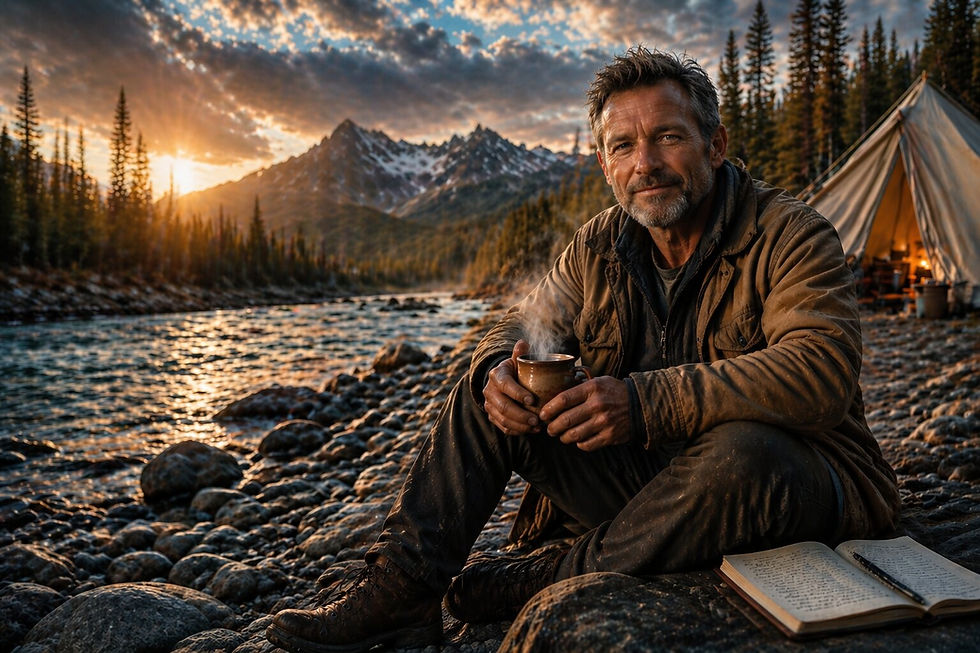
When Thomas finally returned to his tent by the river that morning, he did not feel fixed. He felt something subtler and more important: he felt located. For the first time in years, he knew where he was, not geographically, but existentially. He was a man in the middle of his life who had been carrying too much alone for too long, and who had just discovered that the weight was not his to carry solo. The river had told him that. Or the silence had. Or the first grey light through the spruce needles. He was not sure which mattered. What mattered was that he had listened.
Integrated well-being, the harmonious care of body, mind, heart, and spirit, is not a modern wellness trend. It is the oldest understanding of health that our species possesses. The Medicine Wheel teaches it. The talking circle practises it. The vision quest enacts it. Modern psychology is slowly catching up, recognizing through decades of research what Indigenous traditions have known for millennia: that you cannot heal the mind while ignoring the body, that you cannot restore the body while neglecting the spirit, and that none of it works in isolation from community (Umberson and Montez, 2010; Chandler and Lalonde, 2008).
Men's organizations rooted in this holistic understanding are not asking men to reject strength. They are asking them to expand it. Authentic power is not the capacity to endure pain without flinching. It is the courage to name the pain, to invite others into it, and to discover that vulnerability shared in a trusted circle does not diminish a man; it deepens him. The Brotherhood Code, as practised in various men's communities, calls this radical self-ownership: taking full responsibility for one's shadows and one's growth, not as a solitary burden but as a shared commitment within a circle of accountability and compassion.
There is a particular kind of fire that men describe when they speak about these experiences. Not the destructive fire of burnout or rage, but something closer to what the ancients meant by the word hearth, a fire that warms, that draws people closer, that makes a space feel like home. It is the fire of recognition: the moment you look across a circle and see your own struggle reflected in another man's eyes, and you understand, in your bones, that you are not the only one. It is the fire that Thomas felt beginning to kindle on that riverbank. The fire that James felt when he finally let himself weep in front of witnesses. The fire that Kwame has not yet found but is, perhaps, beginning to look for. It is the fire that burns away pretence and leaves something honest and enduring in its place.
One more practice, then. This one is for the end of your day. Before you sleep, take a piece of paper or open a blank page on your phone (if that is more accessible) and write three sentences. Just three. The first sentence completes this prompt: "Today, I carried..." Name what you bore, whether it was worry, frustration, grief, or the simple exhaustion of holding everything together. The second sentence completes: "Today, I noticed..." Name a moment of sensation, beauty, or feeling that passed through you, however briefly. The third sentence completes: "Tomorrow, I want to..." Name one small, specific action oriented toward connection, rest, or honesty. This is not conventional journaling. It is a daily rite of self-witnessing, a three-sentence ceremony that takes less than two minutes and begins the practice of paying attention to your own inner life with the same care you extend to everything and everyone else.
The Invitation
There is a moment in van Gennep's model that deserves our attention one final time: the moment of incorporation, when the person who has crossed the threshold is welcomed back into the community with a new identity and a renewed sense of belonging. This final stage is not a solitary achievement. It requires witnesses. It requires a community that recognizes the transformation and affirms, "We see who you are becoming. You belong here."
The men's organizations described in this article, and the many others like them, from the DUDES Club in British Columbia to the Moose Hide Campaign to community-based talking circles and wilderness retreats across the country, exist because men need those witnesses. They exist because the research is unambiguous: social connection saves lives (Canadian Mental Health Association [CMHA] Ontario, 2025; Umberson and Montez, 2010). They exist because Indigenous wisdom traditions and modern psychology converge on the same truth: that human beings are wired for belonging, and that the path to authentic power runs not away from vulnerability but directly through it.
If you are reading this and recognizing something of yourself in these pages, in Thomas's silence, in Kwame's busy solitude, in James's sixty-year drought of tears, then you are already standing at a threshold. The fact that you have read this far is itself a kind of crossing. Something in you is paying attention, even if another part is already composing reasons to dismiss it. You do not need to have it all figured out. You do not need to be in crisis. You do not need to be certain. You only need to be willing to take one step.
That step might be as simple as trying one of the practices described above. It might be texting a friend to say, "I have been thinking about you. How are you really doing?" It might be searching for a men's circle, a support group, a wilderness retreat, or a community organization that aligns with your values and your needs. Resources pages maintained by organizations committed to men's well-being, including the one curated by Beyond Brotherhood, list dozens of communities, programs, and pathways for men of all ages, backgrounds, and starting points. There is no single right door. There are many doors. The important thing is to walk through one.
Because here is what Thomas discovered on that riverbank, what James discovered in that circle, what the Haudenosaunee youth of Ohero:kon discover every year in the forests of Akwesasne, and what traditions stretching back thousands of years have always known: you do not have to walk this alone. None of us does. The threshold is real. The passage is ancient. The wilderness, both the one outside your door and the one inside your chest, is waiting to teach you what it knows. And on the other hand, your brothers are waiting.
Brother, you are right on time.

References
Bly, Robert. (2015). Iron John: A Book About Men. Hachette Books. ISBN 9780306824265.
Canadian Mental Health Association [CMHA] Ontario. (2025, June 13). The Quiet Crisis: Why So Many Men Feel Alone. Retrieved from https://ontario.cmha.ca/news/the-quiet-crisis-why-so-many-men-feel-alone/.
Centennial College. (n.d.). Ceremonies and Socials. Our Stories: First Peoples in Canada. In Introduction to Indigenous Studies, retrieved from https://ecampusontario.pressbooks.pub/indigstudies/chapter/ceremonies-and-socials/
Chandler, Michael J.; and Lalonde, Christopher E. (2008). Cultural Continuity as a Protective Factor Against Suicide in First Nations Youth. Horizons - A Special Issue on Aboriginal Youth, Hope or Heartbreak: Aboriginal Youth and Canada's Future, 10(1), 68-72.
Department of Justice Canada. (2025, November 25). Understanding the Experiences of Indigenous Youth Offenders with the Criminal Justice System. State of the Criminal Justice System Dashboard, retrieved from https://justice.gc.ca/socjs-esjp/en/Youth/yi.
Illuman. (n.d.). About: We Exist to Help Men Heal, Connect, and Find Deeper Purpose. Retrieved from https://www.illuman.org/about/.
Journeymen USA. (n.d.). Home. Retrieved from https://www.journeymen.us/.
Liang, Thomas. (2024). The Indigenous Medicine Wheel. Undergraduate Research in Natural and Clinical Science and Technology (URNCST) Journal, 8(11).
ManKind Project Canada. (n.d.). Are You Ready to Awaken the Man You Want to Be? Retrieved from https://www.mankindproject.ca/.
Public Health Agency of Canada. (2026, January 12). Suicide, Self-Harm, and Suicide-Related Behaviours in Canada. Suicide Mortality, retrieved from https://health-infobase.canada.ca/mental-health/suicide-self-harm/suicide-mortality.html.
Robinson, Amanda. (2018, March 20). Vision Quest. The Canadian Encyclopedia, retrieved from https://www.thecanadianencyclopedia.ca/en/article/vision-quest
Running Strong for American Indian Youth. (2020). Under the Husk: A Rites of Passage Ceremony for Haudenosaunee Youth. Retrieved from https://indianyouth.org/oherokon-under-the-husk-15-years-of-rites-of-passage-ceremony/
Sharp, Paul; Oliffe, John L.; Kealy, David; Rice, Simon M.; Seidler, Zac E.; and Ogrodniczuk, John S. (2024). A Survey of Canadian Men's Mental Health in the Workplace. Cogent Mental Health, 3(1), 1-16.
Statistics Canada. (2021, November 24). Canadian Social Survey – Loneliness and Social Networks. The Daily. Retrieved from https://www150.statcan.gc.ca/n1/daily-quotidien/211124/dq211124e-eng.htm.
Statistics Canada. (2023, June 12). Men's Mental Health: How are Canadian Men doing? Retrieved from https://www.statcan.gc.ca/o1/en/plus/3811-mens-mental-health-how-are-canadian-men-doing.
Statistics Canada. (2025, February 19). Loneliness by Gender and Province. Table: 45-10-0048-01, retrieved from https://www150.statcan.gc.ca/t1/tbl1/en/tv.action?pid=4510004801
The Harvard Project on American Indian Economic Development. (2015). Ohero:kon Youth Rites of Passage. "Under the Husk" Rites of Passage, Haudenosaunee Confederacy, Google Arts and Culture, retrieved from https://artsandculture.google.com/story/ohero-kon-youth-rites-of-passage-program-honoring-nations/6wWBYI5dhscjyA?hl=en.
Turner, Victor. (1996). The Ritual Process: Structure and Anti-Structure (Foundations of Human Behavior). Aldine Transaction, ISBN 9780202011905.
Umberson, Debra; and Montez, Jennifer Karas. (2010). Social Relationships and Health: A Flashpoint for Health Policy. Journal of Health and Social Behavior, 51(1 Suppl), S54-S66.
van Gennep, Arnold; Vizedon, Monika; and Caffee, Gabrielle L. (1960). The Rites of Passage. University of Chicago Press, ISBN 9780226848495.
Woods, Stephanie. (2025, May 28). Never Alone: Why Connection Is Key to Men's Mental Health. Canadian Men's Health Foundation [CMHF], retrieved from https://menshealthfoundation.ca/mental-health/canadian-mens-mental-health-research-2025/.
© Citation:
Pitcher, E. Mark. (2026, May 25). Standing at the Threshold: Understanding Rites of Passage for Modern Men. Beyond Brotherhood. https://www.beyondbrotherhood.ca/post/standing-at-the-threshold-understanding-rites-of-passage-for-modern-men.
About the Author
Mark Pitcher lives where the mountains keep their oldest promises, in a valley in the Canadian Rockies, where glacier-fed waters carve poetry into stone and the night sky burns with a silence so vast it feels like truth speaking. Half the year, he calls this wilderness home, no paved roads, no lights, no noise but the heartbeat of the land. It is here, between two ancient peaks and the hush of untouched forest, that Mark's soul was reforged in the fires of meaning and purpose.
Today, Mark stands as a bridge between two worlds: the untamed wilderness that shapes him and the global brotherhoods that inspire him, WYLDMen, MDI, Connect'd Men, Illuman, Man-Aligned, Sacred Sons, UNcivilized Nation, and The Strenuous Life. He walks among these circles as a brother, a man who has risen with a purpose that hums like thunder beneath his ribs.
His vision is now focused on a singular horizon: the creation of the Beyond Brotherhood Retreat Centre. Mark is currently scouting the rugged landscapes of the Rockies, searching for the specific soil and stone that will hold this sanctuary. This is the next great ascent, a mission to secure a permanent home for men to gather, a place where the land itself becomes the teacher.
Mark's teachings are a constellation of old and new: Viktor Frankl's pursuit of meaning, Indigenous land teachings, the cold bite of resilience training, the quiet medicine of Shinrin-yoku, the flowing strength of Qigong, and the fierce ethics of the warrior who knows compassion is a weapon of liberation. A student of Spiritual Care at St. Stephen's College and a seeker of Indigenous truth and reconciliation at the University of Calgary, he is training to guide others into the healing arms of the forest and cold water.
Mark Pitcher is a man rebuilt in the open, a guide, a mentor, and a storyteller whose voice feels like a compass. He is a wilderness warrior who carries warmth like a fire in the night, a man who says, "You don't have to walk this alone. None of us do." His presence steadies and softens, reminding men of a primal belonging they have long forgotten.
Beyond Brotherhood is the living proof of his promise: a vision shaped by courage and unwavering love, a future sanctuary where men remember who they are, who they were, and who they can still become. Mark's upcoming book will dive even deeper into the rise of wilderness-led masculinity and the return of men to purpose, connection, and meaning.
If your heart is thundering as you read this, that is the signal. That is the call. Mark extends his hand to you with the warmth of a fire in winter: You belong here. Your story belongs here. Your strength belongs here. Walk with him. Into the wilderness. Into the circle. Into the life that's been waiting for you.
The journey is only beginning, and Mark is already at the trailhead, looking back with a smile that says: "Brother, you're right on time."


Comments