

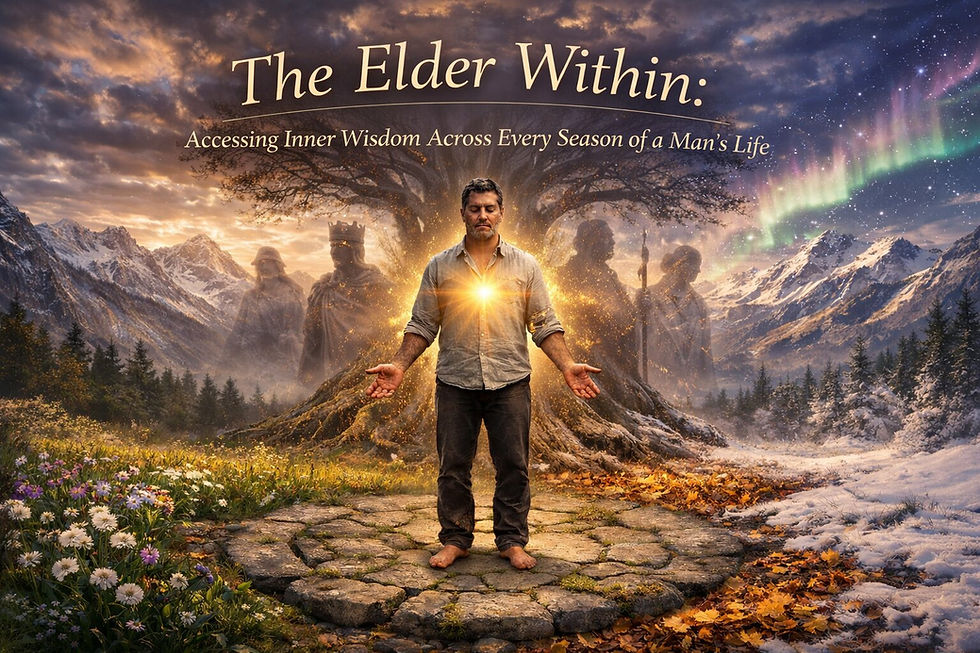
The Elder Within: Accessing Inner Wisdom Across Every Season of a Man's Life
- Mark Pitcher
- Apr 27
- 23 min read
Thomas leans forward in his chair, the worn leather creaking beneath him, and wraps both hands around a ceramic mug that has long since gone cold. He is seventy-two. Outside the window of the community centre in Lethbridge, Alberta, the late-autumn wind pushes dry leaves across the parking lot in small, restless circles. Inside, the room smells of coffee and cedar, a bundle of sage rests on the windowsill, a gift from a Blackfoot Elder who spoke here last month. Thomas watches the young man across from him, Liam, twenty-four, hoodie pulled up, one knee bouncing beneath the table. Liam's eyes are fixed on the floor.
"I keep waiting," Liam says, barely above a whisper. "For something to click. Like there's supposed to be this moment where I... know who I am."
Thomas nods slowly. He does not rush to fill the silence. He has learned, through decades of mistakes, through a marriage that nearly ended, through the death of his closest friend on a frozen highway outside Pincher Creek, that silence is not emptiness. It is an invitation.
"I waited too," Thomas says finally. "For about forty years."
Liam looks up.
This is not a story about two men finding easy answers. It is a story about what happens when a young man's restlessness meets an older man's hard-won stillness, and both are changed. It is a story about the elder within, that quiet, knowing voice inside every man, regardless of age, that speaks when we finally stop performing long enough to listen.
The Silence Between Men
Something is breaking in the inner lives of Canadian men, and the fracture lines run deeper than most of us are willing to admit. In late 2023, 50% of Canadian men aged fifteen and older rated their mental health as excellent or very good, a number that sounds reassuring until you sit with what it means: half of all men in this country do not feel well (Statistics Canada, 2023). Among those who rarely or never felt lonely, 64% reported strong mental health; among those who often felt lonely, that number collapsed to 33% (Statistics Canada, 2024). Loneliness is not a minor inconvenience. It is a fault line.
The crisis is sharpest among the young. 67% of Canadian men aged 19 to 29 report experiencing social isolation, the highest rate among all age groups (Woods, 2025). Nearly a quarter of these young men are at significant risk of depression, yet 67% have never sought professional support (Woods, 2025; Canadian Mental Health Association [CMHA] Ontario, 2025). They are drowning in plain sight, and most of them have been taught that asking for a lifeline is a sign of weakness.
At the other end of the spectrum, the numbers carry a different weight. Men account for over 75% of all suicide deaths in Canada and are three times less likely than women to seek help for mental health concerns (Centre for Addiction and Mental Health [CAMH], n.d.; The Lonely Man, n.d.). Suicide is the second leading cause of death for Canadian men under fifty (Statistics Canada, 2024; The Lonely Man, n.d.). For Indigenous men, the rate is double the national average; for Inuit men, it is eleven times higher (The Lonely Man, n.d.). These are not abstract statistics. They are fathers, brothers, sons, and friends, men whose inner lives became so unbearable that they saw no other way out.
And yet, woven through this data is a thread of possibility. The same research that documents the crisis also points toward what heals: connection, mentorship, and the presence of someone who has walked the road before you and is willing to walk it again beside you. The question is not whether men need guidance. The question is why we have built a culture that makes it so difficult to ask for it, and what happens when we begin to reclaim what was lost.

What Was Lost: The Mentorship Gap
Liam works in logistics for a distribution company in Calgary. He is good at his job, efficient, reliable, the kind of employee who never misses a deadline. He is also profoundly alone. When he started the position two years ago, there was no one to show him the unwritten rules, no one to sit with him over lunch and say, "Here is what I wish someone had told me." He figured it out on his own, the way he has figured out most things since his parents' divorce when he was fourteen.
Liam's experience is not unusual. A 2025 survey by Robert Half found that 47% of Canadian workers entering the workforce felt they lacked a workplace peer to guide them, identifying limited mentorship as their primary challenge (Hudes, 2025). Sixty-six percent of Canadian businesses lack formal mentorship programs, despite 75% having employees retire in the past two years (Globe Newswire, 2023). The institutional knowledge that once flowed naturally from experienced workers to newcomers is evaporating, and no one has built a pipeline to replace it.
But the mentorship gap extends far beyond the workplace. Research from the RAND Corporation reveals that boys and young men from lower-income households have significantly more limited access to adult male mentors (Bozick and Wenger, 2025). This is not merely a professional inconvenience; it is a developmental crisis. Mentored youth report fewer symptoms of depression and social anxiety, stronger coping skills, and greater self-esteem (MENTOR, 2021). Mentorship provides what so many young men are missing: a confidential space to process anxieties before they escalate into crises, and a living example of how to navigate difficulty with integrity (Phillips, n.d.; Project Skills Mentor, n.d.).
The loss is not one-sided. When older men step into mentoring roles, they experience what researchers describe as a renewed sense of purpose, reduced stress, and greater life satisfaction, a "helper's high" linked to lower rates of depression and anxiety (Panagiotakopoulos, 2024; Mutual of Omaha, 2025). The elder who mentors is not simply giving; he is receiving something essential for his own well-being. The relationship is reciprocal, a circle rather than a line.
Consider Deepak, fifty-six, a civil engineer in Brampton who immigrated from Punjab thirty years ago. His three adult children live under the same roof, a multigenerational household, one of 2.4 million in Canada as of 2021, a number that grew by 21.2% over the previous decade (Galbraith and Laflamme, 2025). For Deepak, this arrangement is not a concession to housing costs, though those pressures are real. It is a continuation of something his own father modelled: the daily, unglamorous work of passing wisdom forward. Every evening after dinner, Deepak sits with his youngest son, Arjun, twenty-three, and they talk about work, about relationships, about what it means to be a man who honours both his heritage and his evolving self. Over half of those in multigenerational households in Canada are racialized, and these living arrangements are significantly less likely to result in poverty (Galbraith and Laflamme, 2025). Economic resilience is real, but so is the emotional architecture: a built-in structure for the kind of intergenerational mentorship that Western individualism has largely dismantled.
What Deepak offers Arjun is not a curriculum. It is present. It is the accumulated weight of a life lived with intention, offered freely, without expectation of return. It is the elder within, made visible.
Ancient Maps for Modern Men: The Elder Archetype
The idea that wisdom lives inside us, not as a destination we arrive at in old age but as a capacity we can access at any point in our lives, is not new. It is, in fact, one of the oldest ideas in human psychology.
Carl Jung called it the Wise Old Man, or senex: a universal archetype of the collective unconscious that represents meaning, wisdom, and the integration of the self (Eternalized, 2023a). He appears in our dreams and our stories as the mentor figure, Merlin, Gandalf, the village elder who speaks in riddles that only make sense years later. The Wise Old Man typically emerges during what Jung called individuation, the lifelong process of becoming who you truly are. But he carries a shadow: a rigid, cynical intellectual who hoards knowledge as power and severs himself from feeling (Eternalized, 2023a). Every man who has used his experience to dismiss rather than guide has met this shadow.
The senex exists in dynamic tension with its opposite: the Puer Aeternus, the "eternal boy." Jungian analyst Marie-Louise von Franz described the puer as an adult man whose emotional life remains adolescent, living a "provisional life," avoiding commitment, and fantasizing that his real life has yet to begin (Eternalized, 2022; von Franz, 2000). The puer is not without gifts: he carries creativity, spontaneity, and an openness to possibility. The psychological task is not to kill the boy but to integrate him with the elder's discipline and groundedness.
This is the tension Liam carries in his body every day, the restless energy of a young man who senses he is capable of more but cannot find the container to hold it. And it is the tension Thomas navigated for decades before he learned that wisdom was not about having answers but about being willing to sit with questions.
Robert Moore and Douglas Gillette built on Jung's foundation with their model of four archetypes of mature masculinity: the King, who provides order and blessing; the Warrior, who acts with discipline and purpose; the Magician, who transforms and illuminates; and the Lover, who connects and vitalizes (Moore and Gillette, 1991; Skiellum, 2024). Each archetype has a shadow; the King becomes the Tyrant or the Weakling, the Warrior becomes the Sadist or the Masochist, and the work of maturation is learning to hold the full spectrum without collapsing into either extreme.
Franciscan friar Richard Rohr frames this journey as the movement between the "two halves of life" (Rohr and Martos, 2022). The first half is about building identity: career, relationships, reputation. The second half, often initiated by failure, loss, or suffering, is about discovering what lies beneath the identity you have constructed. It requires moving from dualistic thinking, right or wrong, strong or weak, success or failure, to a more integrated consciousness. Rohr calls this the journey "from Wild Man to Wise Man" (Rohr and Martos, 2022).
Thomas did not read Jung or Rohr. He does not use words like "individuation" or "non-dualistic consciousness." But he knows the territory. At forty-three, his marriage was failing. He was drinking too much. He had built a successful carpentry business and a reputation as a man who could fix anything, except himself. The crisis that cracked him open was not dramatic. It was a Tuesday evening when his wife, Sandra, looked at him across the kitchen table and said, quietly, "I don't know who you are anymore. I'm not sure you do either."
That sentence became his initiation. Not a ceremony in the woods, though those would come later. A single, devastating moment of truth spoken by someone who loved him enough to stop pretending.

The Living Library: Indigenous Perspectives on Elderhood
Within Indigenous cultures across Canada, the concept of the Elder carries a weight and specificity that the English word "elder" barely approximates. An Elder or Knowledge Keeper is not simply an older person. They are individuals recognized by their community for a deep understanding of traditional teachings, ceremonies, language, and the accumulated wisdom of lived experience (First Nations Pedagogy Online, n.d.; Holo, 2021; Regional Municipality of Wood Buffalo, n.d.).
Elders are the living libraries of their nations, teachers, spiritual leaders, healers, and guardians of culture (First Nations Pedagogy Online, n.d.; Regional Municipality of Wood Buffalo, n.d.). Their role is to transmit holistic, relational knowledge that connects humans to the land, the spiritual world, and one another. This stands in contrast to Western approaches that tend to compartmentalize knowledge into discrete disciplines (Kiburo and Zhu, 2024; Leveridge, 2024). The Assembly of First Nations formally recognizes this role through its Council of Elders, also known as the Knowledge Keepers Council, which provides spiritual and political guidance to the national body (Assembly of First Nations, n.d.; Bernard, n.d.).
Intergenerational knowledge transfer is the cornerstone of Indigenous Knowledge Systems. Wisdom passes from Elders to youth through oral traditions, storytelling, ceremonies, and direct experience on the land (Kiburo and Zhu, 2024; Leveridge, 2024). Among the Cree, Elders are the primary custodians of stories that teach good thought and action, the origins of their people, and the meaning of Cree identity (Ermine, n.d.). They teach foundational principles such as Wahkotowin, the recognition that all beings are related, and Tapwewin, the obligation to speak the truth (Aseniwuche Winewak Nation, n.d.).
Engaging with an Elder requires specific protocols rooted in respect. In many First Nations and Metis communities, it is customary to offer traditional tobacco when requesting advice, a gesture that honours the knowledge being shared as a gift, not a commodity (Regional Municipality of Wood Buffalo, n.d.; University of Ottawa, n.d.).
There is something profoundly instructive here for all men, regardless of cultural background. The Indigenous model of elderhood reminds us that wisdom is not a personal achievement to be displayed on a shelf. It is a communal resource, held in trust, passed forward with care. It is relational. It is embodied. And it is inseparable from responsibility.
When Thomas sits with Liam in that community centre in Lethbridge, he is not an Indigenous Elder. He would never claim that title. But he is drawing from the same well: the understanding that his suffering has value only if it becomes useful to someone else. That his silence is not withdrawal but an offering. The young man across from him does not need a lecture. He needs a witness.
Practices for Accessing the Elder Within
Understanding the elder archetype intellectually is one thing. Embodying it is another. The journey from knowledge to wisdom requires practice, not as a self-improvement project but as a way of being. What follows are three practices drawn from contemplative traditions, psychological research, and the lived experience of men who have done this work. They are offered as invitations, not prescriptions. You choose your path.
The first practice is the Council with the Elder Meditation. Thomas learned a version of this from a men's circle he joined at fifty-one, after his friend's death on that frozen highway. The practice is simple. Find a quiet place where you will not be interrupted. Sit comfortably. Close your eyes. Take several slow breaths until your body begins to settle. Then, in your imagination, picture yourself walking along a trail, it might be a mountain path, a forest road, or a shoreline. Let the landscape emerge naturally; do not force it. As you walk, you come to a clearing, and seated there is a figure: an older version of yourself, or perhaps a wise presence that feels familiar but is not anyone you know. This is your inner elder. Sit with him. Ask him one question, whatever is most alive in you right now. Then listen. Do not rush the answer. It may come as words, an image, a feeling, or simply a quality of stillness. When you are ready, thank him and walk back along the trail.
Thomas practises this meditation most mornings, sitting in the same chair by the window where he drinks his coffee. "Some days I get nothing," he says. "Some days I get something that changes how I move through the whole week. The point isn't the answer. The point is remembering that the question matters."
This practice draws on the Jungian tradition of active imagination. It aligns with Richard Rohr's description of contemplation: the development of a non-dualistic mind capable of holding complexity without collapsing into easy answers (Rohr and Martos, 2022). It is also consonant with the experiential approach used by organizations like Illuman, whose Men's Rites of Passage is a five-day immersive retreat that uses ancient rituals, nature, and group connection to guide men through a modern initiation (Illuman, n.d.). The MROP is not a lecture-based programme; it is an experiential process designed to address grief, examine life's priorities, and awaken a deeper sense of masculine spirituality (Illuman, n.d.; Illuman of Minnesota, n.d.).
The second practice is the Intentional Silence Hour. Liam discovered this one by accident. His phone died on a Saturday morning, and instead of charging it immediately, he went for a walk along the Bow River without it. No music. No podcasts. No notifications. Just the sound of water over stone and the crunch of gravel under his boots. He walked for an hour and returned feeling something he could not name, a spaciousness in his chest, as though a fist he did not know was clenched had finally opened.
The practice is exactly what it sounds like: one hour per week of intentional silence: no screens, no input, no agenda. Walk, sit, or be. The silence is not about deprivation; it is about creating space for the inner voice that is perpetually drowned out by noise. For men who have been socialized to measure their worth by productivity, doing nothing can feel like a radical act. That discomfort is part of the practice.
Liam has kept this up for three months now. He does not call it meditation, mindfulness, or any other word that might make him feel self-conscious. He calls it "the quiet hour." It is the one time each week when he is not performing for anyone, not his boss, not his friends, not the version of himself he presents on social media. "I don't know if I'm finding wisdom," he says. "But I'm finding out what I actually think. That feels like a start."
This practice resonates with the growing body of research on contemplative silence and its effects on emotional regulation, self-awareness, and stress reduction. It also mirrors the structure of peer-facilitated men's groups offered by organizations such as ManKind Project Canada, where men gather in confidential circles to practise emotional intelligence, accountability, and integrity (ManKind Project Canada, n.d.). These groups, known as I-Groups, provide ongoing support following MKP's flagship New Warrior Training Adventure, a forty-eight-hour modern male initiation designed to help men examine their lives and develop a more authentic sense of self (ManKind Project Canada, n.d.).
The third practice is Elder Within Journaling, rooted in the expressive writing research pioneered by Dr. James Pennebaker. The protocol is straightforward: write about your deepest thoughts and feelings regarding a stressful or significant experience for 15 to 20 minutes over several consecutive days (Mirgain and Singles, 2016; The Change Companies, n.d.). Decades of research have demonstrated that this practice leads to significant improvements in both physical and psychological health, including improved immune function, reduced anxiety and depression, and better emotional processing (Mirgain and Singles, 2016).
For men who have been socialized to inhibit emotional expression, this private, structured practice can be a vital outlet. It allows you to construct a coherent narrative around difficult experiences and gain new perspectives without the vulnerability of speaking aloud to another person, at least not yet (The Change Companies, n.d.). The Elder Within Journaling variation adds one element: after writing freely for fifteen minutes, pause. Then write a response to yourself from the perspective of your inner elder, the wisest, most compassionate version of yourself. What would he say to you about what you have written? What would he notice that you have missed?
Deepak, the civil engineer in Brampton, began journaling after his father's death three years ago. He writes in a mix of Punjabi and English, the languages of his two lives. "My father never wrote anything down," Deepak says. "Everything he knew, he carried in his body. When he died, I realized how much I had absorbed without knowing it. The journaling helps me find what he left inside me."
This is the elder within at work: not an abstract concept but a living presence, shaped by every relationship, every loss, every moment of courage and failure that has brought you to this point. The practice is not magical. They are disciplined. They are the slow, patient work of turning toward yourself with the same attention you have been trained to direct outward.

The Reciprocal Gift: What Eldering Gives Back
There is a persistent myth in our culture that mentorship flows in one direction: from the wise to the unwise, from the old to the young, from the one who has arrived to the one who is still searching. The reality is far more interesting.
When Thomas began meeting Liam, first through a community mentorship programme, then informally, over coffee and walks along the coulees, he expected to offer guidance. What he did not expect was how much he would receive. Liam's questions, raw and unfiltered, forced Thomas to examine assumptions he had carried for decades without scrutiny. Liam's willingness to say "I don't know" reminded Thomas of the courage he had lost somewhere along the way to becoming an expert in his own life.
Research confirms this reciprocity. Mentors experience a renewed sense of purpose, reduced stress, and greater life satisfaction (Panagiotakopoulos, 2024; Mutual of Omaha, 2025). The act of guiding another person combats the very isolation that erodes men's mental health across the lifespan. For older men facing retirement, the loss of professional identity, or the death of peers, mentorship offers something irreplaceable: the knowledge that your experience matters, that your suffering was not wasted, that you are still needed.
And for younger men like Liam, the presence of an elder, whether a formal mentor, a family member like Deepak, or a figure encountered in a men's circle, provides what no amount of online content or self-help literature can replicate: a living, breathing example of a man who has been broken and rebuilt, who carries his scars without shame, and who shows up anyway. Elder mentors help young men see beyond immediate challenges and grasp the bigger picture (Phillips, n.d.). They act as living examples of integrity and commitment, passing on values and life skills not learned in formal education (Phillips, n.d.). Research consistently shows these relationships lead to improved mental health, increased self-esteem, and a stronger sense of purpose (MENTOR, 2021; Mutual of Omaha, 2025).
The distinction between formal and informal mentorship matters here. Informal relationships, those that develop spontaneously based on mutual identification, tend to be longer and are associated with greater perceived effectiveness (Holt et al., 2016; Dahlberg, and Byars-Winston, 2019). But formal programmes are critically important for men from underrepresented groups who face barriers to accessing informal networks (Scutelnicu Todoran, 2023). Both forms have value. The key is intentionality: the conscious decision to seek guidance or to offer it.
Every Season: The Elder Within Across a Lifetime
The elder within is not a destination you reach at sixty-five. It is a capacity that exists in every season of a man's life, waiting to be accessed.
At twenty-four, Liam's elder within shows up as the part of him that chose to walk along the Bow River instead of numbing out with his phone. It is the voice that told him to say yes when a friend invited him to a men's gathering, which he would have dismissed a year ago. It was the instinct that brought him to that community centre in Lethbridge, even though every part of his socially conditioned self told him that asking for help was a sign of weakness.
At fifty-six, Deepak's elder within is the quiet authority he brings to his evening conversations with Arjun, not the authority of a man who demands obedience but the authority of a man who has earned trust through consistency, humility, and the willingness to say, "I was wrong about that. Let me tell you what I learned."
At seventy-two, Thomas's elder within is the stillness he offers Liam. It is the patience to let silence do its work. It is the hard-won knowledge that wisdom is not about having the right answers but about being present enough to ask the right questions.
The psychological literature supports this developmental view. Moore and Gillette's archetypal framework suggests that mature masculinity is not a fixed state but an ongoing process of integration, a continuous balancing of the King's order, the Warrior's discipline, the Magician's insight, and the Lover's connection (Moore and Gillette, 1991). Rohr's "two halves of life" model reminds us that the passage into deeper wisdom is often initiated not by achievement but by failure, loss, and the willingness to let go of the identity we have constructed (Rohr and Martos, 2022).
The Cree principle of Wahkotowin, the recognition that all beings are related, offers perhaps the most expansive frame (Aseniwuche Winewak Nation, n.d.). If we are all connected, then the elder within is not merely a personal resource. It is a communal one. When one man accesses his inner wisdom, the ripple extends outward, to his family, his friendships, his community, and to men he may never meet but whose lives are shaped by the culture he helps create.

Into the Circle
None of this work is meant to be done alone. That is perhaps the most important thing to say, and the hardest for many men to hear.
The elder within awakens in a relationship. He is called forth by the young man's honest question, by the friend who refuses to accept "I'm fine" as an answer, by the circle of men who gather regularly to practise the terrifying, liberating act of telling the truth about their lives. Across Canada, men's organizations are creating spaces for exactly this kind of work, from wilderness retreats in the Rockies to peer-facilitated circles in urban community centres, from Indigenous-led ceremonies to modern initiations rooted in ancient wisdom.
These spaces are not therapy, though they can be therapeutic. They are not a religion, though they often touch the spiritual. They are containers for the kind of honest, vulnerable, accountable connection that most men have been taught to avoid and that, in their quietest moments, most men know they desperately need.
If you are a young man like Liam, wondering when your life will begin to make sense, it begins when you stop waiting and start asking. Find a men's group. Attend a gathering. Sit in a circle where the only requirement is honesty. You do not need to have your life figured out. You need to show up.
If you are a man in midlife like Deepak, carrying the weight of responsibility and wondering if there is more, there is. The second half of life is not decline. It is an invitation to depth. Your experience is not a burden; it is a gift waiting to be offered. Find a younger man who needs what you know. Mentor him. Let his questions crack you open again.
If you are an older man like Thomas, wondering whether your best years are behind you, they are not. The elder within does not retire. He deepens. Your stillness is medicine for a world addicted to noise. Your presence is a lifeline for men who have never seen what it looks like to age with grace, honesty, and unshakable inner strength.
Men's organizations dedicated to this work exist across the country and around the world. They are built on the understanding that masculinity is not a problem to be solved but a gift to be developed, through brotherhood, through vulnerability, through the ancient and ongoing practice of men gathering to tell the truth. If you have been searching for a community that honours all of who you are, your strength and your tenderness, your ambition and your doubt, your wounds and your wisdom, know that these communities are waiting for you. Explore them. Find the one that fits. Take the first step.
It is late afternoon in Lethbridge now. The light through the community centre window has gone amber, and the wind has settled. Thomas and Liam talked for two hours, though it didn't feel like two hours. It has felt like something outside of time, the way a good conversation always does when both people are fully present.
Liam pulls his hoodie down. He looks different than he did when he arrived, not transformed, not healed, but slightly more settled, as though something inside him has shifted a few degrees toward centre.
"Can we do this again?" he asks.
Thomas smiles. "Same time next week."
Liam nods and stands. At the door, he pauses. "Thomas? That thing you said earlier, about waiting forty years?"
"Yeah?"
"What happened after you stopped waiting?"
Thomas considers this. He looks out the window at the mountains, barely visible now in the fading light, ancient and patient and utterly indifferent to the small dramas of human life. And yet, somehow, not indifferent at all.
"I started listening," Thomas says. "And I found out the voice had been there the whole time."
The elder within is not something you become. It is something you remember. It lives in the silence between your thoughts, in the stillness beneath your restlessness, in the part of you that has always known, even when you could not hear it, that you are more than what you have been told a man should be.
You do not need to wait forty years. You do not need to wait at all.
Brother, you are right on time.

References
Aseniwuche Winewak Nation. (n.d.). 7 Cree Principles. Retrieved from https://www.aseniwuche.ca/7-cree-principles/.
Assembly of First Nations. (n.d.). Providing AFN Leadership with Assistance, Guidance and Support Rooted in Traditional Knowledge. Retrieved from https://afn.ca/about-us/councils/knowledge-keepers-council/.
Bernard, Joanna. (n.d.). About AFN. AFN in NB, retrieved from https://nbafn.ca/about-2/.
Bozick, Robert; and Wenger, Jennie W. (2025, November 18). The Limited Presence of Male Mentors in the Lives of Boys and Young Men. RAND Corporation, retrieved from https://www.rand.org/pubs/research_reports/RRA4451-1.html
Canadian Mental Health Association [CMHA] Ontario. (2025, June 13). The Quiet Crisis: Why So Many Men Feel Alone. Retrieved from https://ontario.cmha.ca/news/the-quiet-crisis-why-so-many-men-feel-alone/.
Centre for Addiction and Mental Health [CAMH]. (n.d.). Mental Illness and Addiction: Facts and Statistics. Retrieved from https://www.camh.ca/en/driving-change/the-crisis-is-real/mental-health-statistics.
Dahlberg, Maria Lund; and Byars-Winston, Angela (Eds.). (2019). The Science of Effective Mentorship in STEMM. National Academies of Sciences, Engineering, and Medicine; Policy and Global Affairs; Board on Higher Education and Workforce; Committee on Effective Mentoring in STEMM, National Academies Press, PMID: 31958221.
Ermine, Willie. (n.d.). Cree Religious Ethos. University of Saskatchewan, in Indigenous Saskatchewan Encyclopedia. Retrieved from https://teaching.usask.ca/indigenoussk/import/cree_religious_ethos.php
Eternalised. (2022, October 9). Puer Aeternus: The Psychology of the Eternal Child. Retrieved from https://eternalisedofficial.com/2022/10/09/puer-aeternus-psychology/.
Eternalised. (2023, September 25). The Psychology of the Wise Old Man. Retrieved from https://eternalisedofficial.com/2023/09/25/the-psychology-of-the-wise-old-man/.
First Nations Pedagogy Online Project. (n.d.). Elders. Retrieved from https://firstnationspedagogy.ca/elders.html.
Galbraith, Nora; and Laflamme, Nadine. (2025, August 14). Unpacking Canada's Multigenerational Households: A Look at the People Who Call Them Home. Statistics Canada, Demographic Documents, Catalogue No. 91F0015M, retrieved from https://www150.statcan.gc.ca/n1/en/pub/91f0015m/91f0015m2025003-eng.pdf.
Globe Newswire. (2023, December 13). Most Canadian Businesses Lack Mentorship Programs, Losing Institutional Knowledge of Retiring Workers. Financial Post, retrieved from https://financialpost.com/globe-newswire/most-canadian-businesses-lack-mentorship-programs-losing-institutional-knowledge-of-retiring-workers
Holo, Karl S. (2021, January 14). Indigenous Elders in Canada. The Canadian Encyclopedia, retrieved from https://www.thecanadianencyclopedia.ca/en/article/indigenous-elders-in-canada.
Holt, Daniel T.; Markova, Gergana; Dhaenens, Andrew J.; Marler, Laura E.; and Heilmann, Sharon G. (2016). Formal or Informal Mentoring: What Drives Employees to Seek Informal Mentors? Journal of Managerial Issues, 28(1/2), 67-82.
Hudes, Sammy. (2025, April 22). Lack of Mentorship, Inadequate Training Among Challenges for New Workers, Survey Finds. The Globe and Mail, retrieved from https://www.theglobeandmail.com/investing/personal-finance/article-lack-of-mentorship-inadequate-training-among-challenges-for-new/.
Illuman of Minnesota. (n.d.). Men's Rites of Passage. Retrieved from https://illumanofmn.org/mens-rites-of-passage.
Illuman. (n.d.). Longing for Brotherhood, Healing, and Purpose? Retrieved from https://www.illuman.org/.
Illuman. (n.d.). Men's Rites of Passage. Retrieved from https://www.illuman.org/mrop.
Kiburo, Carson; and Zhu, Dominica. (2024, December 17). Safeguarding Indigenous Knowledge through Intergenerational Dialogue, One Indigenous Nation at a Time. Cultural Survival, retrieved from https://www.culturalsurvival.org/publications/cultural-survival-quarterly/safeguarding-indigenous-knowledge-through.
Leveridge, Aubrey Neil. (2024). Indigenous Knowledge Systems and Their Role in Communication. In Communication Strategies: Effective Practices for Natural Resource Professionals. BCcampus Pressbooks, retrieved from https://pressbooks.bccampus.ca/communicationstrategies/chapter/indigenous-knowledge-systems-and-their-role-in-communication/.
ManKind Project Canada. (n.d.). Are You Ready to Awaken the Man You Want to Be? Retrieved from https://www.mankindproject.ca/.
ManKind Project Canada. (n.d.). Our Mission: To Create a Safer World by Growing Better Men. Retrieved from https://canada.mkp.org/what-we-do/.
MENTOR. (2021). Mentoring and Mental Health. Retrieved from https://www.mentoring.org/wp-content/uploads/2021/12/Mentoring-and-Mental-Health.pdf.
Mirgain, Shilagh A.; and Singles, Janice. (2016). Therapeutic Journaling. University of Wisconsin-Madison School of Medicine and Public Health, UW Integrative Health, Department of Family Medicine and Community Health, retrieved from https://www.fammed.wisc.edu/files/webfm-uploads/documents/outreach/im/tool-therapeutic-journaling.pdf
Moore, Robert; and Gillette, Douglas. (1991). King, Warrior, Magician, Lover: Rediscovering the Archetypes of the Mature Masculine. Harper Collins Publishers, ISBN 9780062506061.
Mutual of Omaha. (2025, February 6). Mentoring Benefits in Retirement: Become a Mentor or Mentee. Retrieved from https://www.mutualofomaha.com/advice/health-and-well-being/mental-health/make-a-lasting-change-become-a-mentor-or-find-one-yourself.
Panagiotakopoulos, Foti. (2024, June 21). The Mental Health Benefits of Being a Mentor. GrowthMentor, retrieved from https://www.growthmentor.com/blog/mentorship-and-mental-health/.
Phillips, Mike. (n.d.). The Role of Mentorship in Guiding Boys to Manhood (Helping Teens Adhere to Positive Social Norms). The Carpenter's Shed, retrieved from https://www.thecarpentershed.com/blog/the-role-of-mentorship-in-guiding-boys-to-manhood.
Project Skills Mentor. (n.d.). Mentoring and Mental Health: A Positive Connection. Retrieved from https://projectskillsmentor.com/mentoring/mentoring-and-mental-health-the-benefits-for-both-parties
Regional Municipality of Wood Buffalo. (n.d.). Elders and Knowledge Keepers. Retrieved from https://www.rmwb.ca/communities-and-neighbourhoods/truth-and-reconciliation/learn/elders-and-knowledge-keepers/
Rohr, Richard; and Martos, Joseph. (2022). From Wild Man to Wise Man: Reflections on Male Spirituality. Society for Promoting Christian Knowledge, ISBN 9780281086597.
Scutelnicu Todoran, Gina. (2023). The Contribution of Formal and Informal Mentorship to Faculty Productivity: Views of Faculty in Public Affairs Programs. Journal of Public Affairs Education, 29(4), 404-420.
Skiellum, Eivind Figenschau. (2024). King, Warrior, Magician, Lover (KWML) – Archetypes of the Mature Masculine. Masculinity-Movies.com, retrieved from https://www.masculinity-movies.com/articles/king-warrior-magician-lover.
Statistics Canada. (2023, June 12). Men's Mental Health: How are Canadian Men doing? Retrieved from https://www.statcan.gc.ca/o1/en/plus/3811-mens-mental-health-how-are-canadian-men-doing.
Statistics Canada. (2024, June 10). Statistical Checkup of Canadian Men's Health. Retrieved from https://www.statcan.gc.ca/o1/en/plus/6413-statistical-checkup-canadian-mens-health.
The Change Companies. (n.d.). Write Your Secrets: What James Pennebaker Discovered About Expressive Writing. Retrieved from https://blog.changecompanies.net/james-pennebaker-expressive-writing
The Lonely Man. (n.d.). Statistics. Retrieved from https://lonelyman.ca/stats
University of Ottawa. (n.d.). Elders and Traditional Knowledge Keepers. Indigenous Resource Centre, retrieved from https://www.uottawa.ca/about-us/sites/g/files/bhrskd336/files/2021-09/icca_19_1126_reference_guide_eng_final2.pdf.
von Franz, Marie-Luise. (2000). The Problem of the Puer Aeternus (3rd ed.). Inner City Books, ISBN 9780919123885.
Woods, Stephanie. (2025, May 28). Never Alone: Why Connection Is Key to Men's Mental Health. Canadian Men's Health Foundation [CMHF], retrieved from https://menshealthfoundation.ca/mental-health/canadian-mens-mental-health-research-2025/.
© Citation:
Pitcher, E. Mark. (2026, April 27). The Elder Within: Accessing Inner Wisdom Across Every Season of a Man's Life. Beyond Brotherhood. https://www.beyondbrotherhood.ca/post/the-elder-within-accessing-inner-wisdom-across-every-season-of-a-man-s-life
About the Author
Mark Pitcher lives where the mountains keep their oldest promises, in a valley in the Canadian Rockies, where glacier-fed waters carve poetry into stone and the night sky burns with a silence so vast it feels like truth speaking. Half the year, he calls this wilderness home, no paved roads, no lights, no noise but the heartbeat of the land. It is here, between two ancient peaks and the hush of untouched forest, that Mark's soul was reforged in the fires of meaning and purpose.
Today, Mark stands as a bridge between two worlds: the untamed wilderness that shapes him and the global brotherhoods that inspire him, WYLDMen, MDI, Connect'd Men, Illuman, Man-Aligned, Sacred Sons, UNcivilized Nation, and The Strenuous Life. He walks among these circles as a brother, a man who has risen with a purpose that hums like thunder beneath his ribs.
His vision is now focused on a singular horizon: the creation of the Beyond Brotherhood Retreat Centre. Mark is currently scouting the rugged landscapes of the Rockies, searching for the specific soil and stone that will hold this sanctuary. This is the next great ascent, a mission to secure a permanent home for men to gather, a place where the land itself becomes the teacher.
Mark's teachings are a constellation of old and new: Viktor Frankl's pursuit of meaning, Indigenous land teachings, the cold bite of resilience training, the quiet medicine of Shinrin-yoku, the flowing strength of Qigong, and the fierce ethics of the warrior who knows compassion is a weapon of liberation. A student of Spiritual Care at St. Stephen's College and a seeker of Indigenous truth and reconciliation at the University of Calgary, he is training to guide others into the healing arms of the forest and cold water.
Mark Pitcher is a man rebuilt in the open, a guide, a mentor, and a storyteller whose voice feels like a compass. He is a wilderness warrior who carries warmth like a fire in the night, a man who says, "You don't have to walk this alone. None of us do." His presence steadies and softens, reminding men of a primal belonging they have long forgotten.
Beyond Brotherhood is the living proof of his promise: a vision shaped by courage and unwavering love, a future sanctuary where men remember who they are, who they were, and who they can still become. Mark's upcoming book will dive even deeper into the rise of wilderness-led masculinity and the return of men to purpose, connection, and meaning.
If your heart is thundering as you read this, that is the signal. That is the call. Mark extends his hand to you with the warmth of a fire in winter: You belong here. Your story belongs here. Your strength belongs here. Walk with him. Into the wilderness. Into the circle. Into the life that's been waiting for you.
The journey is only beginning, and Mark is already at the trailhead, looking back with a smile that says: "Brother, you're right on time."


Comments