

The Silence Between Us: Bridging the Gap Between Fathers and Sons Across Generations

The rain falls in thin, grey curtains over the cemetery this May afternoon, the kind of rain that does not pound but persists, quiet, relentless, like grief itself. Martin stands before a granite headstone, fifty-one years old, his work boots sinking into the softened earth. In his left hand, he holds a single sheet of paper, folded twice, the ink already beginning to bleed where the rain finds the creases. It is a letter he wrote three years ago, the morning after his father's funeral, when the words finally came, too late for the living, but urgent enough to demand a page.
He unfolds it now. His hands tremble, not from the cold.
"Dear Dad," he reads aloud, his voice barely rising above the sound of water on stone. "I spent my whole life trying to make you proud. I got the grades. I got the job. I built the house. And I never once heard you say you were proud of me. I know you were. Mom told me. Your brother told me. Everyone knew except me, because you never said it. And I never said what I needed to say either. I love you. I always loved you. I didn't know how to reach across whatever was between us."
Martin folds the letter and presses it against his chest. His father, William, worked two jobs for 31 years, millwright by day and custodian three evenings a week, and never once complained. He drove a rusted Ford pickup until the odometer rolled past three hundred thousand kilometres, not because he could not afford a new one but because replacing something that still ran struck him as wasteful. He shovelled the neighbour's driveway without being asked. He sat in the front row at every school concert, arms folded, jaw set, radiating a pride he could not name. He provided everything a family could need materially: a warm home, reliable vehicles, and groceries that never ran short. What he could not provide, or did not know how to provide, was the language of the heart. William came from a generation of men who expressed devotion through presence at the dinner table and paycheques on the counter, not through words like "I love you," or "I'm proud of you," or "Tell me what's on your mind."
Standing in the rain, Martin realizes he has inherited the same silence. His own son, now twenty-four, texts more than he calls. Their conversations orbit logistics: car insurance, holiday plans, the score of last night's game. The deeper currents, fear, ambition, loneliness, and love, remain untouched, as though an unspoken agreement binds them to the surface.
Martin is not a failure. Neither was William. They are links in a chain forged long before either of them was born, shaped by wars they did not fight, economic hardships they did not choose, and cultural codes they absorbed before they could question them. The silence between fathers and sons is rarely the product of indifference. More often, it is the residue of love that was never given a vocabulary.
The Weight of What Goes Unsaid
Martin's story is not unusual. It is, in fact, so common that researchers have been able to measure its consequences with startling precision. The relationship between a father and his son is one of the most formative bonds in human development. When that bond is strained by emotional distance, or severed by absence, the effects ripple outward across a lifetime.
The data is sobering. In Canada, four out of five suicides are male, a statistic the Canadian Mental Health Association identifies as a crisis rooted in societal pressures on masculinity and a pervasive reluctance among men to seek help (Canadian Mental Health Association [CMHA], 2024). Children who grow up without an engaged father are twice as likely to attempt suicide and account for three out of every four teen suicides in the country (Canadian Centre for Men and Families [CCMF], n.d.). They comprise eighty percent of adolescents admitted to psychiatric hospitals and are twenty times more likely to be incarcerated at some point in their lives (Canadian Centre for Men and Families [CCMF], n.d.; Canadian Children's Rights Council, n.d.). These are not marginal effects. They represent a generational pattern with devastating downstream consequences for families, communities, and the health-care system.
Yet the picture is not one of unrelenting decline. Canadian fatherhood is evolving. Statistics Canada (Houle, et al., 2017) reports that fathers' participation in household work rose from 51% in 1986 to 76% in 2015, and the proportion of fathers providing direct childcare increased from roughly 1 in 3 to 1 in 2 over the same period. The number of stay-at-home fathers in Canada has increased tenfold since 1976, now representing one in ten stay-at-home parents (Statistics Canada, 2024). In Quebec, the introduction of the Quebec Parental Insurance Plan led to a nearly tripling of paternal leave uptake, from 28% in 2005 to 77% in 2021 (Battams, 2023). Fathers are showing up in new ways, changing diapers, coaching teams, attending school concerts, and yet something essential remains elusive for many: the emotional conversation, the vulnerable exchange, the words that transform a provider into a confidant.
What the statistics reveal is a paradox. Fathers are more physically present than at any point in recent history, but emotional presence has not kept pace. The gap between doing and connecting, between providing and expressing, is where silence lives. And it is in that silence that sons learn to swallow their own unspoken words, perpetuating a cycle that research tells us is not inevitable, but requires conscious, courageous interruption.

The Architecture of Distance
Understanding why fathers and sons struggle to connect requires looking beyond individual families to the historical, psychological, and cultural forces that have shaped masculine expression for generations. Silence is not a personal failing; it is an inheritance.
The Provider Archetype and Its Costs
The Industrial Revolution fundamentally altered the father-son relationship. For centuries, fathers and sons worked side by side, on farms, in workshops, at sea, sharing not only labour but the daily, shoulder-to-shoulder mentorship that Robert Bly (2015) described in Iron John: A Book About Men as the foundation of masculine initiation. When factories drew men out of the home and into wage labour, sons lost access to their fathers' teaching, their stories, their emotional presence. What remained, Bly argued, was the father's "temper, not his teaching" (p. 25), brief, fatigued encounters at the end of long shifts that offered discipline but not intimacy. This created what Bly termed "father hunger": a deep, unmet longing for paternal guidance, affirmation, and emotional connection that many men carry into adulthood without ever naming it.
Two World Wars deepened the wound. Millions of men returned from combat carrying trauma they had no language for and no cultural permission to express. The stoic veteran became an archetype unto himself: strong, silent, reliable, and emotionally unreachable. His sons learned that manhood meant endurance, not expression. His grandsons, men like Martin, inherited the pattern without understanding its origins, mistaking silence for strength because no one had ever shown them the alternative.
The "provider archetype" that emerged from these pressures reduced fatherhood to an economic function. A good father puts food on the table. A great father put his children through university. Emotional availability was not part of the job description; in many households, it was actively discouraged. Developmental psychologist Michael E. Lamb (2010), whose decades of research on father involvement remain foundational, has consistently argued that the quality of the father-child relationship matters more than mere presence or provision. Yet, cultural messaging has been slow to catch up with the science.
The Psychological Roots: Attachment, Trauma, and Transmission
John Bowlby's (1997) attachment theory provides a critical framework for understanding the father-son bond. Bowlby demonstrated that children require a "secure base", a caregiver who is consistently available, sensitive, and responsive,to develop healthy emotional regulation, confidence, and the capacity for intimate relationships. While his early work emphasized the maternal role, subsequent research has confirmed that fathers are equally capable of serving as primary attachment figures, and that a secure attachment to a father can serve as a protective buffer against negative outcomes, even when other relationships are strained (Bowlby, 1990).
When that secure base is absent or unreliable, the effects are profound. Psychiatrist Bessel van der Kolk (2015, in The Body Keeps the Score) explains that trauma is not merely an event in the past but an imprint on the mind, brain, and body that continues to shape behaviour in the present. A father who was terrorized or emotionally neglected by his own father may struggle to provide comfort and security for his son, not because he does not care, but because his nervous system was never taught what safety feels like. Van der Kolk's research on intergenerational trauma reveals that these patterns can be transmitted through both behavioural modelling and epigenetic pathways, creating a biological vulnerability to stress and disconnection that spans generations (van der Kolk, 2020).
Relationship researcher John Gottman (1998) extends this understanding into the practical domain. His work on emotional coaching demonstrates that fathers who learn to recognize, validate, and guide their children's emotions, rather than dismissing or minimizing them, raise sons who are more emotionally intelligent, more resilient, and better able to form healthy relationships. Gottman's research suggests that the capacity for emotional attunement is not innate but learned, meaning the cycle of silence can be broken by any father willing to develop this skill, regardless of his own upbringing.
Cultural Variations: Many Silences, Many Songs
The father-son dynamic is not monolithic; it is profoundly shaped by cultural context. In Blackfoot tradition, the raising of a child was never the sole responsibility of the biological father. It was a community-wide endeavour, embedded in a kinship system where elders, whether biologically related or not, served as mentors, teachers, and spiritual guides. By the age of seven, a Blackfoot child was expected to have a clear understanding of social responsibilities and moral behaviour, instilled through sacred societies and individual grandparents who taught self-control, empathy, and deference to others' needs (Lethbridge Family Centre, n.d.; Delaney, 2021). The Blackfoot word for "my father" is Nin na. Still, the concept of fatherhood extended far beyond biology, into a web of collective care in which every adult bore responsibility for the next generation.
This model was violently disrupted by colonization and the residential school system, which severed the connection between children and their families, cultures, and languages. The breakdown of traditional mentoring relationships has been directly linked to social distress and interpersonal violence within Blackfoot communities (Barsh, n.d.). Healing, in the Blackfoot worldview, is not an individual pursuit but an intergenerational and community-wide process rooted in the revitalization of culture, language, and ceremony, a profound challenge to Western mental health paradigms that often focus on the isolated self (Cambridge University Press, 2015).
Other Indigenous nations echo this emphasis. In Cree culture, fathers were integral to transmitting survival and cultural skills, with elders passing down stories that defined what it meant to live in right relationship with the community and the natural world (Ermine, n.d.). Métis culture, born of the union of First Nations and European peoples, emphasized the transmission of knowledge through oral tradition and mentorship, with sons often following their fathers into the fur trade and acquiring wilderness skills, trade practices, and languages through direct observation (Préfontaine, n.d.; Vizina, n.d.). These Indigenous models offer a powerful corrective: fatherhood is not an isolated role but a shared responsibility, deeply embedded in culture, spirituality, and the community's collective well-being.
The Nordic countries present a different kind of lesson. Sweden introduced gender-neutral parental leave in 1974 and a dedicated "daddy quota" in 1993, deliberately recoding cultural expectations around fatherhood. The result has been a measurable shift: Nordic fathers now spend significantly more time with their young children than fathers in most other developed nations, and the cultural ideal has shifted from the emotionally reserved patriarch to the nurturing, present partner (Farstad and Stefansen, 2015; Daily Scandinavian, 2026). This demonstrates that the silence between fathers and sons is not biologically determined; it is culturally constructed and can be culturally dismantled.
In Canada's multicultural landscape, immigrant families navigate additional complexities. First-generation fathers from East Asian, South Asian, and Middle Eastern traditions may carry cultural values emphasizing filial obligation, respect for hierarchy, and emotional restraint. At the same time, their Canadian-born sons absorb Western ideals of individualism and self-expression (Inman et al., 2007). The resulting tension, what researchers call "acculturation discrepancy", can create a profound sense of living two lives: one at home, governed by paternal expectations; one outside, shaped by peer culture and personal aspiration. The father feels his authority eroding; the son feels misunderstood. Neither has the language to bridge the gap, because the gap itself is cultural, not merely personal.
What all these cultural contexts share is a single insight: healing the father-son relationship requires understanding the forces that shaped it. No father chose silence in a vacuum. The work of reconnection begins not with blame but with context, and from context, compassion.
James is seventeen, Cree-Metis, and lives with his mother in Saskatoon. He has not seen his father in four years. When he talks about it, rarely, and only with his school counsellor, he does not use the word "abandoned." He says, "He just wasn't around." The flatness in his voice is its own kind of eloquence.
James does not know that his father, Robert, attended a residential school until age 14. Robert has never spoken about those years to anyone, including his own mother. The silence that James interprets as indifference is, in fact, the outer wall of a fortress Robert built around unbearable pain. Robert did not choose distance. Distance was the only survival strategy he was ever taught.
In a community healing circle last spring, an elder told James something that shifted something inside him: "Your father's absence is not about you. It is about what was done to him and to his father before him. You are not the cause. But you can be the one who changes the direction." James carries those words like a stone in his pocket, smooth from turning.
Amrit is thirty-eight, a software engineer in Vancouver, born to Punjabi Sikh parents who immigrated to Canada in 1979. His father, Harjeet, is seventy-two and still rises at five o'clock every morning, a habit forged during decades of running a small grocery store in Surrey. Their relationship is defined by what is present: duty, respect, shared meals on Sundays, and by what is absent: any conversation about fear, doubt, loneliness, or love.
"My dad sacrificed everything so I could have this life,” Amrit says. "And I'm grateful. But gratitude isn't the same as closeness. I know everything about his work ethic and nothing about his inner world. I don't know what he dreams about. I don't know what he's afraid of. And he doesn't know those things about me either, because we've never had that kind of conversation. It's like there's a glass wall between us; you can see through it, but you can't touch."
Amrit recognizes the acculturation gap described by researchers. He grew up navigating two worlds: the Punjabi household, where emotional restraint signalled respect, and the Canadian schoolyard, where vulnerability was beginning to be reframed as strength. He does not blame his father. He understands that Harjeet expressed love the only way he knew how: through sacrifice, provision, and an unwavering commitment to showing up. But understanding is not the same as connection, and Amrit has begun to wonder whether it is possible to honour his father's cultural values while also reaching for something more.

Three Practices for Bridging the Silence
Healing the father-son relationship does not require grand gestures or dramatic confrontations. More often, it begins with small, deliberate acts of courage: a journal entry, a single honest sentence, a letter read aloud to the wind. The following three practices are drawn from therapeutic research, men's healing work, and the lived experience of men who have walked this path. They are offered not as prescriptions but as invitations, starting points for a journey that will look different for every father and every son.
Practice One: The Unspoken Inventory
Find a quiet place, a room where you will not be interrupted, a bench in a park, a seat in your parked car at the end of the day and write down everything you wish you could say to your father. Do not edit. Do not censor. Do not worry about grammar or fairness or whether your feelings are "reasonable." This is not a letter you will send; it is an excavation. Write the praise you never offered. Write the questions you never asked. Write the anger, the gratitude, the confusion, the love. Let the pen move until it stops on its own.
Then, on a separate page, write down everything you wish your son would say to you. What do you long to hear? What acknowledgement would heal something inside you? This second list is often more revealing than the first, because it illuminates what you yourself are withholding.
The Unspoken Inventory is rooted in expressive writing research, which has demonstrated that translating emotional experiences into language can reduce psychological distress and improve physical health outcomes (Pennebaker, 1997). It is not a substitute for conversation, but it is often a necessary precursor, a way of discovering what you actually feel before you attempt to share it with another person.
Practice Two: The Bridge Conversation Guide
If your father is alive, or if you have a son with whom the silence has grown heavy, consider initiating what therapists sometimes call a "bridge conversation", a single, intentional exchange designed not to resolve everything but to open a door. The following guidelines are drawn from Gottman's (1998) research on emotional communication and from the practices of men's healing circles:
Begin with honesty about the difficulty itself. Say: "There's something I've wanted to tell you, and I'm not sure how to say it." This statement does two things: it signals importance and lowers the other person's defences by revealing your own vulnerability. Use "I" statements rather than "you" statements. "I felt alone when we stopped talking about real things" lands differently than "You never talked to me about anything real." The first invites connection; the second invites defence.
Ask one question you have never asked before: "What do you wish I understood about your life?" Then listen. Do not fix. Do not rebut. Do not fill the silence that follows. Silence, in this context, is not emptiness; it is space, the kind of space that allows something new to grow. If the conversation is short, awkward, or ends in a long pause, followed by a change of subject, that is enough. The bridge does not need to be crossed in a single conversation. It only needs to exist.
Practice Three: The Posthumous Reconciliation Ritual
For men like Martin, whose fathers have already died, the conversation may seem impossible. But the need for reconciliation does not expire with the death of the other person. Psychologists who work with grief consistently affirm that the relationship with a deceased parent continues to evolve; what changes is not the bond but the medium through which it is expressed (Klass et al., 1996).
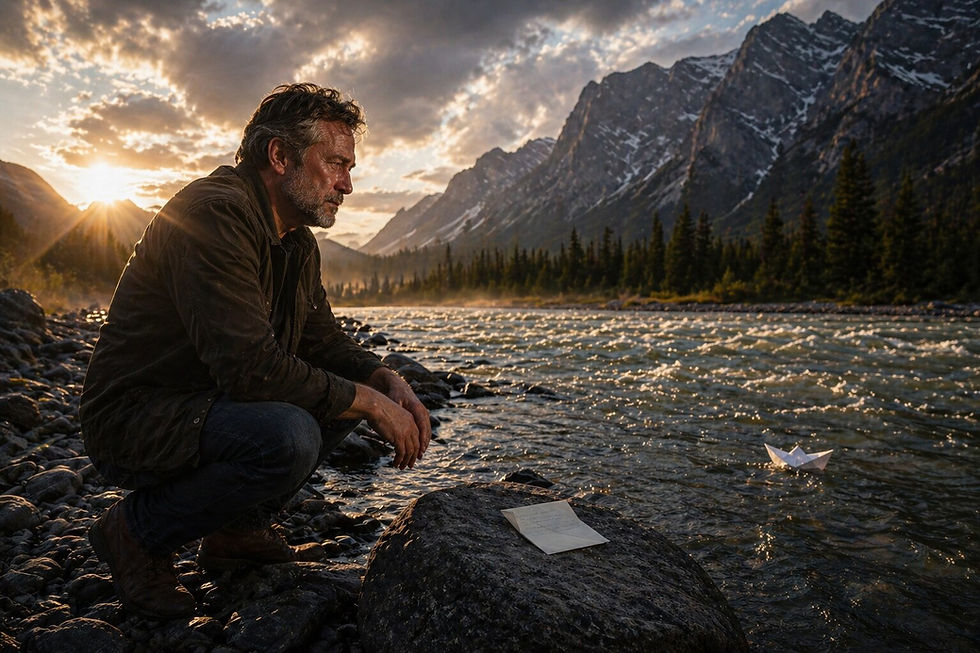
Write a letter to your father. Say everything. Then take it to a place that held meaning in your relationship, a fishing spot, a workbench, a kitchen table, a grave. Read it aloud. Let your voice carry the words into the air, even if it cracks, even if you weep. When you have finished, release the letter in whatever way feels right: bury it in the earth, burn it and scatter the ashes, fold it into a paper boat and set it on moving water. The act of physical release is not symbolic in the way that word is sometimes used to mean "merely decorative." It is a somatic completion, a way of telling the body that the words have finally been delivered, that the silence has been broken, even if only one voice was speaking.
Martin performed this ritual on a September morning, reading his letter aloud at his father's headstone for the second time. "The first time was about my grief," he says. "The second time was about letting it go. Not letting him go, I'll never do that. But let go of the regret. The 'I should have said this.' The 'Why didn't you say that?' I said it. That's what matters now."

The Circle Where Wounds Are Witnessed
There is a particular kind of relief that comes from saying the unsayable in the presence of other men who understand. Not therapists, though therapy is vital and should never be dismissed. Not partners, though their support matters deeply. But men who carry the same wound, who nod slowly when you describe the hollow feeling of standing in your father's house and feeling like a stranger, who do not flinch when your voice breaks because theirs has broken in the same way, in the same place in the story.
Across Canada and around the world, men's organizations have recognized that the father wound is not peripheral to masculine development; it is central. In men's circles, retreats, and structured rites of passage, the silence between fathers and sons is named, witnessed, and gently challenged. These spaces operate on a principle that runs counter to the cultural script most men absorbed in childhood: that vulnerability is not weakness but the foundation of authentic strength. In such circles, a man does not need to demonstrate competence or project control. He is invited to tell the truth about his life simply and to discover that his truth is not unique, shameful, or disqualifying, but shared, human, and worthy of compassion.
The ManKind Project, for example, offers the New Warrior Training Adventure, a forty-eight-hour retreat described as a modern male initiation and a journey of self-examination (ManKind Project, n.d.). MDI (Mentor, Discover and Inspire) offers a 2½ day retreat where you can break free from what's holding you back and reconnect with the best version of yourself (MDI, n.d.; Break Free Seminars, n.d.). Illuman, founded by Franciscan friar Richard Rohr, provides a five-day Men's Rites of Passage that directly confronts "issues of loss, grief, trauma, and relationships with our fathers, other men, and each other" (Illuman, n.d.). These are not the only such organizations; they are part of a growing ecosystem of men's work that includes peer support groups, Indigenous talking circles, faith-based communities, and grassroots brotherhoods that meet in living rooms, church basements, and around campfires in the Canadian wilderness. The common thread is a recognition that healing does not happen in isolation. It happens in relationships, in the witnessing, the accountability, and the belonging that a circle of men can provide.
For many men, entering such a space is the hardest step. The cultural conditioning that tells men to solve their problems alone does not let go easily. But the research is unequivocal: social connection is a protective factor against depression, substance abuse, and suicide (Umberson and Montez, 2010), and men who participate in structured support communities report higher life satisfaction and improved emotional well-being (Chen, 2026). The father wound thrives in secrecy. It begins to heal when it is spoken aloud and met with the words: "I know. I've been there too."
The Letter That Gets Read in Time
Six months after that rainy May afternoon, Martin picks up the phone and calls his son, Daniel.
"I need to tell you something," he says. His voice is steady, but his heart is hammering. "I love you. I don't say it enough. I don't say it at all, really, and I want that to change. I spent my whole life wishing my dad had said it to me, and I've been doing the same thing to you without even realizing it."
There is a long pause on the other end of the line. Martin can hear his son breathing. Then Daniel says, quietly, "I've been waiting a long time to hear that, Dad."
The conversation that follows is not eloquent. It is halting, awkward, full of pauses and half-finished sentences. They talk about hockey and then, without transition, about loneliness. Daniel admits he has been struggling at work, not with the tasks themselves but with the feeling that he is performing a version of himself that does not quite fit, a mask he put on somewhere in his twenties and cannot seem to remove. Martin admits he does not know how to help but wants to try. He tells his son something he has never told anyone: that he felt the same way at twenty-four, and at thirty-four, and that it was not until he stood at his own father's grave that he understood the cost of pretending. They stay on the phone for forty-seven minutes, longer than any call they have had in years, and when they hang up, neither of them has solved anything. But something has shifted. The glass wall that Amrit described, transparent but impenetrable, has developed its first crack.
"I don't want him standing at my grave with an unread letter," Martin says later. "That's what it comes down to. My dad couldn't give me the words. Maybe his dad couldn't give them to him. But the chain has to break somewhere, and I decided it breaks with me."
The silence between fathers and sons is old. It predates any of us. It was shaped by wars, by industrial economies, by cultural codes that confused emotional restraint with masculine virtue. It was deepened by colonization, by immigration, by the thousand daily pressures that conspire to keep men from speaking the truths that matter most. And it is perpetuated every time a father tells himself, "He knows I love him; I don't need to say it," or a son tells himself, "He wouldn't understand anyway, so why try?"
But the silence is not destiny. It is a habit, and habits can be broken. The research is detailed: fathers who engage emotionally with their sons raise young men who are more resilient, more empathetic, and less likely to carry the wound forward into the next generation (Lamb, 2010; Gottman, 1998). Indigenous traditions remind us that fatherhood was never meant to be a solitary role but a community practice, embedded in culture, ceremony, and the wisdom of elders (Wesley-Esquimaux and Smolewski, 2004). Nordic policy demonstrates that entire societies can choose to redefine what fatherhood looks like. And the growing movement of men's organizations, circles, retreats, and rites of passage offers living proof that men are hungry for connection, that the wound is shared, and that healing is possible.
It begins with one man choosing to speak. One father is picking up the phone. One son is writing the letter. One voice in a circle saying, "This is what I carry," and another voice answering, "You don't have to carry it alone."
If you recognize yourself in these pages, if you are the son who never heard the words, or the father who has not yet said them, know that it is not too late. Men's organizations across Canada and beyond exist for precisely this work: to help men name the silence, to hold space for the grief, and to walk alongside one another into a more connected, more honest, more fully alive way of being. Resources are available through community directories, mental health organizations, and platforms such as the Beyond Brotherhood resource page, which catalogues a wide range of men's healing communities to suit different paths and needs.
You do not have to do this alone. None of us does.
Brother, you are right on time.

References
Barsh, Russel. (n.d.) Blackfoot Traditional Models of Aggression and Healing. Harry Frank Guggenheim Foundation, retrieved from https://www.hfg.org/grant_summaries/blackfoot-traditional-models-of-aggression-and-healing/.
Battams, Nathan. (2023, June 15). Fathers Day 2023: Changing Roles, Changing Profiles. Vanier Institute of the Family, retrieved from https://vanierinstitute.ca/resource/fathers-day-2023-changing-roles-changing-profiles/
Bly, Robert. (2015). Iron John: A Book About Men. Hachette Books. ISBN 9780306824265.
Bowlby, John. (1990). A Secure Base: Parent-Child Attachment and Healthy Human Development. Basic Books, ISBN 9780465075973.
Bowlby, John. (1997). Attachment and Loss: Volume 1. Attachment. Pimlico, ISBN 9780712674713.
Break Free Seminars. (n.d.). The Art Of Masculinity: Take the First Step In Your Journey Right Now. Retrieved from https://breakfreeseminars.com/the-art-of-masculinity/.
Canadian Centre for Men and Families [CCMF]. (n.d.). Research Brief: Fatherlessness. Retrieved from https://menandfamilies.org/portfolio/brief_fatherlessness/.
Canadian Children's Rights Council. (n.d.). Fatherlessness in Canada. Retrieved from https://canadiancrc.com/Fatherlessness/Fatherlessness_in_Canada.aspx
Canadian Mental Health Association [CMHA]. (2024, February 22). Men's Mental Health. Retrieved from https://cmhato.org/understanding-mental-health/mens-mental-health/.
Chen, Dalson. (2026). Mental Health and Suicidal Feelings are Still Taboo Subjects for Men, says Windsor-Essex CMHA. CBC News, retrieved from https://www.cbc.ca/news/canada/windsor/mens-mental-health-cmha-9.7067115
Daily Scandinavian. (2026, April 10). Cool Scandinavian Dads. Retrieved from https://www.dailyscandinavian.com/cool-scandinavian-dads/
Delaney, Julius. (2021, March 2). People and Family. Galt Museum and Archives, retrieved from https://www.galtmuseum.com/blackfoot-1/people-and-family.
Ermine, Willie. (n.d.). Cree Religious Ethos. University of Saskatchewan, Indigenous Saskatchewan Encyclopedia, retrieved fromhttps://teaching.usask.ca/indigenoussk/import/cree_religious_ethos.php
Farstad, Gunhild R.; and Stefansen, Kari. (2015). Involved Fatherhood in the Nordic Context: Dominant Narratives, Divergent Approaches. NORMA: International Journal for Masculinity Studies, 10(1), 55-70.
Gottman, John. (1998). Raising an Emotionally Intelligent Child. Simon and Schuster, ISBN 9780684838656.
Houle, Patricia; Turcotte, Martin; and Wendt, Michael. (2017, June 1). Changes in Parents' Participation in Domestic Tasks and Child Care from 1986 to 2015. Statistics Canada, Catalogue No. 89-652-X2017001, retrieved from https://www150.statcan.gc.ca/n1/en/pub/89-652-x/89-652-x2017001-eng.pdf.
Illuman. (n.d.). Men's Rites of Passage. Retrieved from https://www.illuman.org/mrop.
Inman, Arpana G.; Howard, Erin E.; Beaumont, Robin L.; and Walker, Jessica A. (2007). Cultural Transmission: Influence of Contextual Factors in Asian Indian Immigrant Parents' Experiences. Journal of Counseling Psychology, 54(1), 93-100.
Klass, Dennis; Silverman, Phyllis R.; and Nickman, Steven (Editors). (1996). Continuing Bonds: New Understandings of Grief. Routledge, ISBN 9781560323396.
Lamb, Michael E. (2010). The Role of the Father in Child Development, 5th Edition. John Wiley and Sons, ISBN 9780470405499.
Lethbridge Family Centre. (n.d.). The Blackfoot Framework. Retrieved from https://www.famcentre.ca/the-blackfoot-framework/
ManKind Project. (n.d.). Get Ready for a 48 Hour Adventure that Can Transform Your World as a Man. Retrieved from https://mankindproject.org/new-warrior-training-adventure/
MDI (Mentor, Discover and Inspire). (n.d.) The Art Of Masculinity. Retrieved from https://www.mentordiscoverinspire.org/courses/taom/.
Onciul, Bryony. (2015). Revitalising Blackfoot Heritage and Addressing Residential School Trauma (Chapter 16). In Convery, Ian; Corsane, Gerard; and Davis, Peter (Eds.), Displaced Heritage: Responses to Disaster, Trauma, and Loss. Cambridge University Press, retrieved from https://www.cambridge.org/core/books/abs/displaced-heritage/revitalising-blackfoot-heritage-and-addressing-residential-school-trauma/E2637524614BA2214D8086EE8BBCE555.
Pennebaker, James W. (1997). Opening Up: The Healing Power of Expressing Emotions. Guilford Press, ISBN 9781572302389.
Préfontaine, Darren R. (n.d.). Métis Culture and Language. University of Saskatchewan, Indigenous Saskatchewan Encyclopedia, retrieved from https://teaching.usask.ca/indigenoussk/import/metis_culture_and_language.php
Statistics Canada. (2024, October 8). Changing Profile of Stay-at-Home Parents. Retrieved from https://www150.statcan.gc.ca/n1/pub/11-630-x/11-630-x2016007-eng.htm.
Umberson, Debra; and Montez, Jennifer Karas. (2010). Social Relationships and Health: A Flashpoint for Health Policy. Journal of Health and Social Behavior, 51(1 Suppl), S54-S66.
van der Kolk, B. (2020, September 12). Interrupting Intergenerational Trauma. When Bad Things Happen, retrieved from https://www.besselvanderkolk.com/uploads/docs/Interrupting-Intergenerational-Trauma-participant-version.pdf.
van der Kolk, Bessel. (2015). The Body Keeps the Score: Brain, Mind, and Body in the Healing of Trauma. Penguin Books, ISBN 9780143127741.
Vizina, Yvonne. (n.d.). Our Legacy: Métis culture. Saskatchewan Council for Archives and Archivists, retrieved from https://digital.scaa.sk.ca/ourlegacy/exhibit_metisculture.
Wesley-Esquimaux, Cynthia; and Smolewski, Magdalena. (2004). Historic Trauma and Aboriginal Healing. Aboriginal Healing Foundation, retrieved from https://ehprnh2mwo3.exactdn.com/wp-content/uploads/2021/01/historic-trauma.pdf.
© Citation:
Pitcher, E. Mark. (2026, May 11). The Silence Between Us: Bridging the Gap Between Fathers and Sons Across Generations. Beyond Brotherhood. https://www.beyondbrotherhood.ca/post/the-silence-between-us-bridging-the-gap-between-fathers-and-sons-across-generations.
About the Author
Mark Pitcher lives where the mountains keep their oldest promises, in a valley in the Canadian Rockies, where glacier-fed waters carve poetry into stone and the night sky burns with a silence so vast it feels like truth speaking. Half the year, he calls this wilderness home, no paved roads, no lights, no noise but the heartbeat of the land. It is here, between two ancient peaks and the hush of untouched forest, that Mark's soul was reforged in the fires of meaning and purpose.
Today, Mark stands as a bridge between two worlds: the untamed wilderness that shapes him and the global brotherhoods that inspire him, WYLDMen, MDI, Connect'd Men, Illuman, Man-Aligned, Sacred Sons, UNcivilized Nation, and The Strenuous Life. He walks among these circles as a brother, a man who has risen with a purpose that hums like thunder beneath his ribs.
His vision is now focused on a singular horizon: the creation of the Beyond Brotherhood Retreat Centre. Mark is currently scouting the rugged landscapes of the Rockies, searching for the specific soil and stone that will hold this sanctuary. This is the next great ascent, a mission to secure a permanent home for men to gather, a place where the land itself becomes the teacher.
Mark's teachings are a constellation of old and new: Viktor Frankl's pursuit of meaning, Indigenous land teachings, the cold bite of resilience training, the quiet medicine of Shinrin-yoku, the flowing strength of Qigong, and the fierce ethics of the warrior who knows compassion is a weapon of liberation. A student of Spiritual Care at St. Stephen's College and a seeker of Indigenous truth and reconciliation at the University of Calgary, he is training to guide others into the healing arms of the forest and cold water.
Mark Pitcher is a man rebuilt in the open, a guide, a mentor, and a storyteller whose voice feels like a compass. He is a wilderness warrior who carries warmth like a fire in the night, a man who says, "You don't have to walk this alone. None of us do." His presence steadies and softens, reminding men of a primal belonging they have long forgotten.
Beyond Brotherhood is the living proof of his promise: a vision shaped by courage and unwavering love, a future sanctuary where men remember who they are, who they were, and who they can still become. Mark's upcoming book will dive even deeper into the rise of wilderness-led masculinity and the return of men to purpose, connection, and meaning.
If your heart is thundering as you read this, that is the signal. That is the call. Mark extends his hand to you with the warmth of a fire in winter: You belong here. Your story belongs here. Your strength belongs here. Walk with him. Into the wilderness. Into the circle. Into the life that's been waiting for you.
The journey is only beginning, and Mark is already at the trailhead, looking back with a smile that says: "Brother, you're right on time."


Comments