

The Inner Spring: Releasing Winter's Weight and Awakening to Renewed Purpose in the Masculine Journey

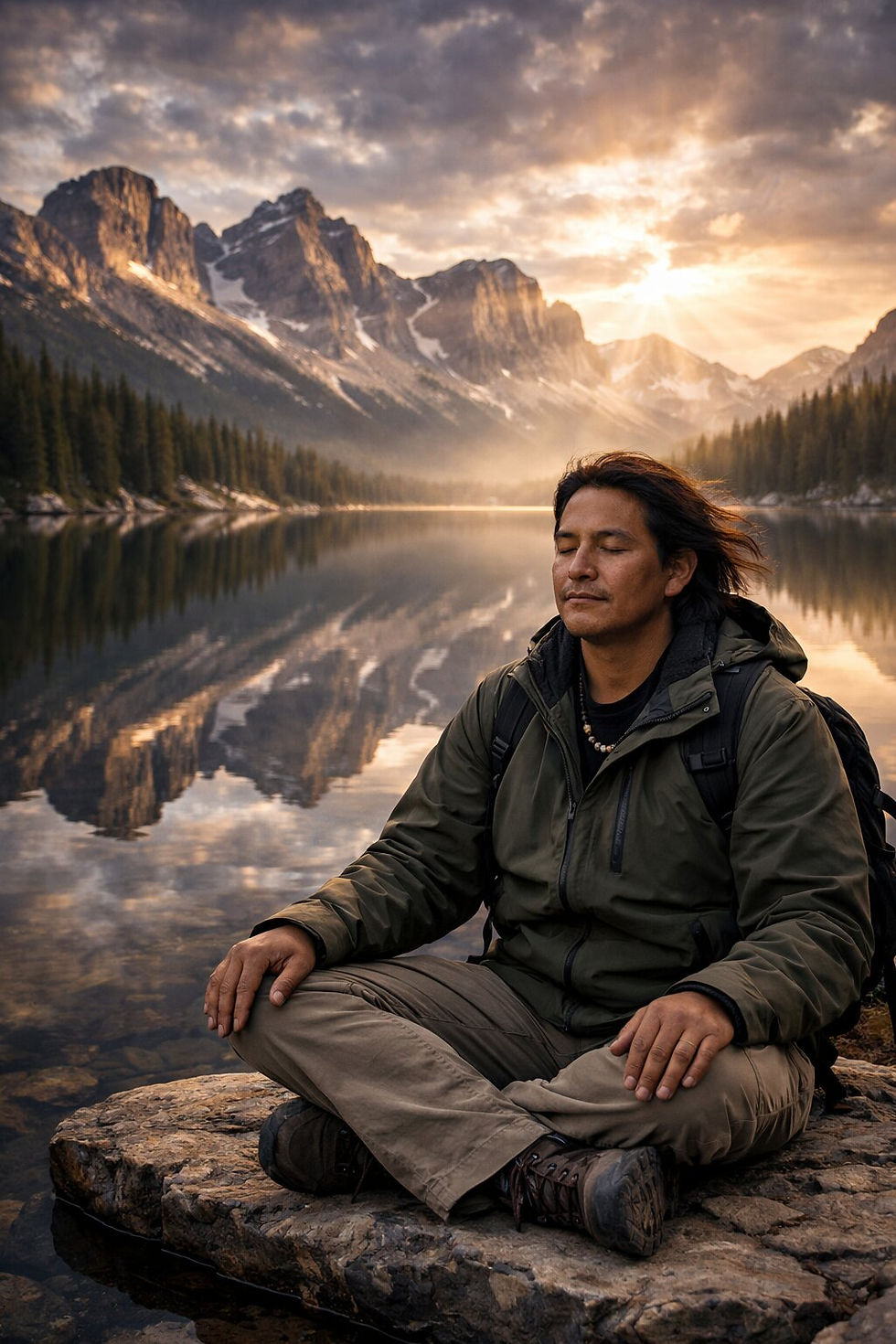
Daniel stands at the edge of the Bow River on a morning in early April, his boots sinking into mud that was frozen solid only two weeks ago. The air is sharp, carrying the clean bite of snowmelt and something older underneath it, the dark, sweet smell of earth waking up after five months of silence. He watches a slab of river ice the size of a kitchen table crack away from the bank, tilt slowly, and slide into the current. It catches the pale morning light for a moment before the water swallows it downstream. Mist rises from the surface where the cold meets the warming air, and the sound is everywhere, a low, constant rushing, punctuated by the sharp report of ice fracturing further upstream, echoing off the valley walls like distant thunder.
He has not come here with a plan. He has come here because the walls of his house, where his father died in January, have become too close. The winter had been long in a way that had nothing to do with weather. His father, a retired millwright from Lethbridge who never once in seventy-four years told his son he loved him, had spent his final weeks in the spare bedroom Daniel converted into a makeshift hospice. Daniel managed the medications, changed the sheets, sat in the hallway at three in the morning listening to laboured breathing through the door. When it was over, people said, "You were so strong through all of that." And Daniel nodded, because that is what men do. They carry it. They hold it together. They do not stand in parking lots at midnight, shaking with their hands, as Daniel actually did twice in February.
Now the river is doing something Daniel has not been able to do. It is letting go. Not gently, not in some tidy metaphorical way, but violently, loudly, with great groaning sheets of ice surrendering to a current that was always moving beneath them. He watches, and something behind his sternum shifts, a pressure he has been calling "fine" for three months. He does not cry. Not yet. But he stays. He stands in the cold mist and the mud and the noise, and for the first time since January, he does not turn away from what he feels.
Daniel is not alone in carrying this kind of weight, though it almost certainly feels that way. Across the country, millions of men are emerging from winter burdened by losses they have not named, grief they have not processed, and a quiet erosion of purpose they cannot quite articulate. The season itself conspires against them. But so does something deeper, a set of unspoken rules about what men are allowed to feel, and when, and in front of whom. This article is about the thaw. Not the one happening on the river, but the one that becomes possible when a man finally permits himself to set something down.
The Weight of the Season
The Canadian winter is not merely an inconvenience; for a significant portion of the population, it is a clinical event. According to the Canadian Mental Health Association, approximately 2% to 3% of Canadians will experience Seasonal Affective Disorder in their lifetime, a subtype of major depression characterized by recurring episodes that emerge in the fall and winter months and remit in the spring (Canadian Mental Health Association [CMHA] British Columbia Division, 2013). Beyond this clinical threshold, an additional 15% of the population, roughly one in six Canadians, experiences a milder but still turning off form of seasonal depression commonly known as the "winter blues" (The Grey Bruce We CARE™ Project, n.d.). Research using data from the Canadian Community Health Survey has found that seasonal variation in depressive symptoms is most pronounced among youth aged 12 to 24, with highly significant increases in symptom scores during winter months compared to summer (Lukmanji et al., 2019). The underlying mechanisms are well established: reduced sunlight disrupts circadian rhythms and suppresses serotonin production, the neurotransmitter most directly linked to mood regulation (Canadian Mental Health Association [CMHA] British Columbia Division, 2013).
But the numbers tell only part of the story. The weight Canadian men carry into spring is not only seasonal but also structural. A landmark 2025 study by the Canadian Men's Health Foundation surveyed 2,000 men aged 19 and older and found that 64% reported moderate-to-high levels of stress, a figure that had risen four percentage points in a single year (Canadian Men's Health Foundation [CMHF], 2025). Nearly a quarter, 23%, were identified as being at risk of moderate-to-severe depression (Canadian Men's Health Foundation [CMHF], 2025). Half of all Canadian men surveyed were at risk of social isolation, a figure that climbed to 73% among men living alone (Canadian Men's Health Foundation [CMHF], 2025). Statistics Canada has confirmed the link between connection and wellness: men who always or often have someone to count on are significantly more likely to report excellent or very good mental health, 55% compared to 38% for those without that support (Statistics Canada, 2023).
Perhaps the most telling statistic is not about prevalence but about silence. A staggering 67% of men in the Canadian Men's Health Foundation [CMHF] study reported that they had never sought professional mental health services (Canadian Men's Health Foundation [CMHF], 2025). This is not because the need is absent. It is because the cultural architecture surrounding masculinity has, for generations, treated emotional disclosure as a structural weakness. Globally, the pattern holds: the World Health Organization reports that depression is a leading cause of disability worldwide, affecting more than 280 million people, yet men in virtually every country are significantly less likely than women to seek treatment (World Health Organization [WHO], 2025). The cost of this silence is not abstract. Of the approximately 4,000 suicide deaths that occur in Canada each year, nearly 75% are men (Centre for Addiction and Mental Health [CAMH], n.d.). Among First Nations youth, the rate is six times the national average; among Inuit youth, it is twenty-four times the national average (Centre for Addiction and Mental Health [CAMH], n.d.).
These are not just data points. They are Daniel, standing at the river. They are the twenty-two-year-old in Scarborough who has not left his apartment in six days. They are the sixty-eight-year-old widower in Prince George who tells his daughter on the phone that everything is fine. The weight is real, measurable, and does not lift on its own.

Why Men Hold On
Marcus is twenty-three and lives in a basement apartment in Brampton. He graduated last spring with a degree in kinesiology, a field he chose because his mother, who emigrated from Kingston, Jamaica, before he was born, told him it would lead to steady work. It has not. He has sent out over 100 applications, landed 2 interviews, and received 1 follow-up email that began with "We regret to inform you." By November, he stopped applying. By January, he stopped going to the gym, which, for a man who once structured his entire identity around discipline and physical strength, felt like a small death. His roommate asked him once, in passing, if he was alright. Marcus said, "Yeah, man, just tired." That was in December. No one has asked since.
Marcus's silence is not a personal failing. It is a predictable outcome of what the American Psychological Association, in its landmark 2018 guidelines for practice with boys and men, identified as "traditional masculinity ideology", a constellation of beliefs that includes anti-femininity, the eschewal of any appearance of weakness, and a relentless drive for achievement and self-sufficiency (American Psychological Association [APA], 2018). Central to this ideology is what psychologists call restrictive emotionality: the learned inhibition of expressing or even experiencing vulnerable emotions (American Psychological Association [APA], 2018). When Marcus tells his roommate he is "just tired," he is not lying. He is performing the only script he has been given. Research has shown that men who internalize norms of restrictive emotionality may actively suppress thoughts that conflict with these norms, paradoxically intensifying the very distress they are trying to contain (American Psychological Association [APA], 2018).
The roots of this script run deep. Studies on parental socialization reveal that mothers tend to discuss emotions such as sadness and fear more frequently with daughters. At the same time, fathers are more likely to discourage displays of sadness in sons, even as they remain attentive to their sons' anger (American Psychological Association [APA], 2018). By the time a boy reaches adolescence, the emotional vocabulary available to him has often been winnowed down to a narrow band: fine, frustrated, angry, tired. The Canadian Men's Health Foundation [CMHF] data bear this out at a population level; young men between 19 and 29 face the highest risk, with 43% at risk for moderate-to-severe depression and 57% experiencing moderate-to-high anxiety (Canadian Men's Health Foundation [CMHF], 2025). Marcus sits squarely in this demographic, carrying the compounded weight of cultural expectation, economic precarity, and the pressure placed on young Black men to project an image of invulnerability in a society that already perceives them through a lens of suspicion.
But the struggle to release is not confined to youth. It spans generations and cultures, and it is not only a Western phenomenon. Indigenous worldviews offer a strikingly different framework, one in which holding on past the proper season is understood not as strength but as a disruption of natural order. The Niitsitapi (Blackfoot) people of the Northern Plains structure their entire way of life around the seasonal round, a dynamic relationship with the land in which each season carries its own responsibilities, ceremonies, and forms of release (First Rider and Golebiowski, 2021). The Blackfoot New Year does not begin on January first. It begins with the first clap of thunder in the spring. This sound signals the earth's reawakening and initiates ceremonies of renewal in which sacred bundles are opened, and commitments to the Creator are renewed (First Rider and Golebiowski, 2021). Winter, in this framework, is not a season to be endured or conquered. It is a season of rest, storytelling, and knowledge transfer, a necessary dormancy that makes the spring's renewal possible. The principle of reciprocity is central: the Niitsitapi observe that when the buffalo bean flowers, the bison are calving, and hunting ceases to allow the herds to replenish (First Rider and Golebiowski, 2021). Life moves in circles, not lines. And what must be set down in one season feeds what grows in the next.
This cyclical wisdom finds a powerful echo in the work of Franciscan priest and author Richard Rohr, whose writing on masculine initiation has shaped a generation of men's work. Rohr argues that modern men suffer from a spiritual void created by the disappearance of formal rites of passage. These structured experiences once taught boys that life is hard, that they are not in control, and that their lives find meaning only when given away in service to something larger than themselves (Illuman, n.d.). Without these initiatory experiences, Rohr contends, men remain trapped in the "false self", an ego-driven identity built on achievement, control, and the avoidance of pain. The passage to the "true self" requires what Rohr calls a "necessary falling," a descent into powerlessness that the uninitiated man will resist with everything he has (Illuman East Coast Collaborative, n.d.). Spring, in this reading, is not simply a change of weather. It is an invitation to undergo the falling that winter has prepared, to let the ice break, to let the current take what must go.

Composting the Dark: Grief, Meaning, and the Work of Release
Joseph is sixty-eight. He retired two years ago from a thirty-one-year career as a high school shop teacher in Thunder Bay, and he has not yet figured out what to do with his hands. His wife, Elaine, died four years before that, of pancreatic cancer, eight weeks from diagnosis to funeral. He handled it the way his generation of Northern Ontario men handles most things: he built a deck. Then he insulated the garage. Then he replaced every window in the house. When he ran out of projects, the silence arrived. He fills it now with the CBC, walks to the Tim Hortons on Red River Road, where he knows the staff by name, and grows aware that what he is feeling is not boredom. It is grief that he postponed with a nail gun and a circular saw.
Joseph's pattern is textbook, and it is not a moral failure. Psychiatrist Elisabeth Kubler-Ross and grief researcher David Kessler identified denial as the first of five stages in the grieving process, not a refusal to acknowledge loss, but a survival mechanism that allows the psyche to absorb only as much pain as it can manage (Kubler-Ross and Kessler, 2007). Anger follows, providing structure in the formlessness of loss. Then bargaining, with its relentless chorus of "what if" and "if only." Then depression, not as a pathology, but as the appropriate weight of confronting what is gone. And finally, acceptance: not being "okay" with the loss, but acknowledging its permanence and learning to reorganize life around it (Kubler-Ross and Kessler, 2007). These stages are not linear. They do not arrive in order, and they do not resolve cleanly. A man can cycle through all five in an afternoon, only to wake up the next morning back in denial.
But Kessler, after the death of his own son, proposed a critical addition: a sixth stage he called finding meaning (Kessler, 2020). This stage does not ask the griever to find a reason for the loss; there may be none. It asks him to find meaning in its wake, to transform the experience of suffering into something that deepens rather than diminishes his life. For Joseph, this might look like mentoring the young apprentices at the community college workshop he has been avoiding. For Daniel, it might mean planting the garden his father always talked about but never started. For Marcus, it might be as simple as telling one person the truth about how he is actually doing. In each case, the release is not an ending. It is a composting, the slow, organic transformation of what was painful into what becomes fertile.
The metaphor is not accidental. In the natural world, nothing is wasted. Fallen leaves become soil. Dead trees become habitat. The Niitsitapi understood this intuitively; the seasonal round is built on the principle that each phase of the cycle feeds the next (First Rider and Golebiowski, 2021). Modern therapeutic practices echo this ancient knowledge. Studies on therapeutic gardening have found that the physical act of working with soil significantly reduces cortisol, the body's primary stress hormone, while improving mood and providing a tangible sense of purpose and hope (Avid Counseling and Consultation Services, n.d.). Research on forest bathing, Shinrin-yoku, the Japanese practice of immersing oneself in a forest environment, has demonstrated measurable reductions in cortisol, enhanced immune function, and decreased rumination on negative thoughts (Elohee Center Inc., 2025). The land, it turns out, is not just a backdrop for healing. It is an active participant.

Practices for the Thaw: Body, Breath, and Burning
Understanding why we hold on is necessary. But understanding alone does not produce release. The body stores what the mind refuses to process, and it must be addressed on its own terms. Neuroscientist Stephen Porges's Polyvagal Theory provides the physiological framework for this claim. Porges identified a three-part hierarchy within the autonomic nervous system, governed largely by the vagus nerve, the longest cranial nerve in the body, which acts as a communication superhighway between the brain and the body's major organs (Porges, 2017; Polyvagal Institute, n.d.). When the nervous system registers safety, the ventral vagal pathway activates, producing a state of calm, social engagement, and regulated breathing. When it detects a threat, the sympathetic nervous system mobilizes the body for fight-or-flight: heart rate spikes, breathing shallows, muscles tense. And when the threat feels inescapable, the oldest pathway, the dorsal vagal system, triggers a shutdown response: numbness, dissociation, collapse (Polyvagal Institute, n.d.).
For men who have spent a winter, or a lifetime, in sympathetic overdrive or dorsal shutdown, the path back to ventral safety is not through thinking. It is through the body. Slow, diaphragmatic breathing is one of the most direct methods for stimulating the ventral vagal nerve, sending a signal of safety from the body to the brain that effectively applies what Porges calls a "vagal brake" to the stress response (Porges, 2017). What follows are three practices designed to meet men where they are, in the body, in the natural world, and on the page. They are not prescriptions. They are invitations. Take what resonates. Leave what does not.
The Spring Clearing Walk. Choose a morning. Find a trail, a riverbank, a stretch of shoreline, any place where moving water meets land. Before you begin, pick up a stone that fits in your hand. Hold it. Feel its weight. Let it stand for whatever you have been carrying: the grief, the regret, the anger, the exhaustion, the thing you have not told anyone about. Walk in silence. Do not listen to a podcast. Do not check your phone. Attend to what your feet feel on the ground, what the air smells like, what sounds reach you when you stop generating your own noise. When you reach the water, stop. Speak aloud what the stone represents, even if the words feel foolish, even if your voice shakes. Then set it down. Don't throw it. Set it down, deliberately, at the water's edge. Walk away lighter. This is not magic. It is ritual, and ritual works because it gives the body a physical grammar for what the mind cannot yet articulate. Indigenous cultures across Turtle Island have understood this for millennia; ceremony and the land are inseparable from healing (First Rider and Golebiowski, 2021).
The Release Breathwork Sequence. Find a quiet place. Sit or lie down. Begin with box breathing: inhale through the nose for 4 counts, hold for 4 counts, exhale through the mouth for 4 counts, hold for 4 counts. Repeat this cycle for two minutes. This pattern activates the parasympathetic nervous system and begins to downregulate the stress response (Porges, 2017). Then shift: inhale for four counts, and extend the exhale to eight counts. The extended exhale is the key; it directly stimulates the ventral vagal pathway, signalling to the nervous system that the threat has passed and it is safe to stand down (Polyvagal Institute, n.d.). Continue for three to five minutes. You may notice your shoulders drop. You may notice emotion rising, tears, anger, or a sudden wave of sadness. Let it come. This is not a breakdown. It is discharged. The body is doing what it was designed to do, and you are finally letting it.
The Letter of Release. Take a piece of paper, not a screen, and write a letter to whatever you are carrying. Address it directly: "Dear Regret." "Dear Dad." "Dear Fear of Being Seen." Write honestly about what this burden has cost you, what it taught you, and why you are choosing to set it down now. Do not edit. Do not perform. Let the pen move. When you are finished, take the letter outside. Burn it in a fire pit, bury it in the garden, or tear it into pieces and scatter them in moving water. The act of physical destruction is not violence against the memory. It is a ceremony, a declaration, made with the hands and witnessed by the elements, that you are no longer willing to carry this into the next season of your life. Kubler-Ross and Kessler wrote that grief must be moved through, not around (Kubler-Ross and Kessler, 2007). This is one way through.

You Do Not Have to Carry It Alone
There is a moment in every man's unburdening where solitary practice reaches its limit. The walk is powerful. The breathwork is real. The letter burns, and something genuinely shifts. But the deepest release, the one that rewires not just the nervous system but the story a man tells himself about who he is, happens in the presence of another human being. It happens when a man says, out loud, to someone listening, "This is what I have been carrying."
The data support what the gut already knows. Statistics Canada has shown that men with consistent social support are nearly 50% more likely to report excellent or very good mental health (Statistics Canada, 2023). The DUDES Club, a peer support programme established in 2010 in Vancouver's Downtown Eastside, has demonstrated what becomes possible when men are given a low-barrier, non-clinical, non-judgmental space to connect. An evaluation of 150 participants found that 90.6% reported an improved quality of life across mental, physical, emotional, and spiritual dimensions of health (Gross et al., 2023). The programme's success lies not in professional intervention but in brotherhood, in the simple, radical act of men sitting together, sharing honestly, and discovering that they are not alone in their struggles. The presence of Elders in the DUDES Club gatherings provides cultural grounding, humour, and a living link to traditional knowledge about what it means to be a man in community (Gross et al., 2016).
Marcus would benefit from a space like this, though he does not yet know it. He has never heard a man his father's age say "I was afraid" without it being the setup for a story about overcoming the fear. Joseph would benefit from it too, not as a patient receiving treatment, but as an elder whose decades of quiet endurance have something to teach younger men about resilience, and who might, in the act of teaching, discover that his own grief still has words left unsaid. Daniel, at the river, has already begun. But the river cannot answer back. A brother can.
Naming a burden aloud in the community does something that private reflection cannot. It breaks the isolation that the American Psychological Association [APA] identified as a core consequence of restrictive emotionality (American Psychological Association [APA], 2018). It disrupts the national pattern of silence in Canadian Men's Health Foundation data (Canadian Men's Health Foundation [CMHF], 2025). And it creates what Rohr described as the essential condition for masculine transformation: a container of trust in which a man can fall apart without being destroyed (Illuman, n.d.). The container might be a men's circle. It might be a peer support group. It might be two friends on a fishing boat who finally stop talking about the fish. The form matters less than the function: a space where the full weight of a man's experience is welcomed, witnessed, and honoured.
Seeds
It is late April now. The snow has retreated to the highest ridges above Canmore, and the valley floor is greening with the determined urgency of a season that knows it is short. Daniel is kneeling in a raised bed he built last weekend from reclaimed lumber. His hands are in the soil, and the soil is cold and damp and alive in a way that surprises him every time. He is planting peas, sugar snaps, the kind his father used to grow in the backyard in Lethbridge and eat raw off the vine, never quite waiting for them to be ready. Daniel did not plan this. He is not honouring his father's memory in some deliberate, curated way. He is just planting peas because something in him wanted to, and for the first time in months, he followed the want instead of analyzing it.
Something has shifted. He would not call it healing, because that word implies a destination, and he is not there. He would not call it closure, because nothing about losing his father feels closed. If he had to name it, he might say space. There is space now where the pressure used to be. Not because the grief is gone, it is not gone, and he suspects it never will be, but because he stopped insisting on carrying all of it, all the time, by himself. He went back to the river. He carried a stone. He set it down. He called his friend Ray and said, "I'm not doing great," and Ray said, "Yeah, I know. Come over." That was it. No dramatic breakthrough. No catharsis on a mountaintop. Just a man telling the truth to another man who was willing to hear it.
Marcus, in Brampton, has started walking again. Not to the gym, not yet, but around the neighbourhood, early, before the streets fill up. He found a breathwork video online and tried it in his room with the door closed, feeling ridiculous for the first two minutes and then unexpectedly shaky for the next five. He texted his cousin afterward: "Can we talk this week? Like, actually talk." His cousin said yes. It is not everything. But it is a beginning.
Joseph, in Thunder Bay, signed up to volunteer at the community college workshop. He told the coordinator he could teach basic cabinetry two mornings a week. On his first day, a nineteen-year-old apprentice asked him how to fix a dovetail joint he had botched, and Joseph showed him. For twenty minutes, he was not a retired man filling time. He was a man with something to give. That evening, he sat at the kitchen table where Elaine used to sit, and he wrote her a letter. He told her about the kid with the dovetail joint. He told her he missed her. He folded the letter, walked to the backyard, and buried it next to the lilac bush she planted the year they moved in. The ground was soft enough to dig. Spring had come.
Spring does not ask us to erase winter. It asks us to compost it, to trust that what was dark, heavy, and seemingly barren has been preparing the ground for something new all along. The grief does not disappear. The loneliness does not vanish. The years of silence do not undo themselves overnight. But the ice breaks. The current moves. The soil warms. And if we are willing, even slightly, even reluctantly, to participate in the thaw, something green and unexpected pushes through.
You do not have to do this alone. None of us does. Across the country, men's organizations are building the kind of spaces where release is possible, and brotherhood is real, communities grounded in the understanding that authentic strength includes the courage to be vulnerable, that emotional honesty is not weakness but wisdom, and that the journey toward wholeness is never meant to be walked in isolation. A listing of these communities, and the resources to support your own inner spring, can be found at www.beyondbrotherhood.ca/resources.
This week, take one step. Just one. Walk to the water and set something down. Breathe slowly for five minutes and let your body say what your words have not. Write the letter. Call the friend. Sit in the dirt and plant something. The season is turning. The river is moving. And you, brother, you are right on time.
References
American Psychological Association [APA]. (2018). APA Guidelines for Psychological Practice with Boys and Men. Retrieved from https://www.apa.org/about/policy/boys-men-practice-guidelines.pdf.
Avid Counseling and Consultation Services. (n.d.). Therapeutic Gardening: Mental Health Benefits of Nature. Retrieved from https://www.avidcounseling.org/therapeutic-gardening-mental-health-benefits-of-nature/
Canadian Men's Health Foundation [CMHF]. (2025, May 28). 2025 Canadian Men's Health Report. Retrieved from https://menshealthfoundation.ca/research/2025-mens-mental-health-research/.
Canadian Men's Health Foundation [CMHF]. (2025, May 29). New Study Shows Significant Decline in Men's Mental Health; Half Lack Sufficient Social Support. Retrieved from https://menshealthfoundation.ca/press/2025-study-stress-depression-canadian-men/.
Canadian Mental Health Association [CMHA] British Columbia Division. (2013). Seasonal Affective Disorder. Retrieved from https://bc.cmha.ca/documents/seasonal-affective-disorder-2/.
Centre for Addiction and Mental Health [CAMH]. (n.d.). Mental Illness and Addiction: Facts and Statistics. Retrieved from https://www.camh.ca/en/driving-change/the-crisis-is-real/mental-health-statistics.
Elohee Center, Inc. (2025, May 29). 10 Ways Nature Supports Emotional Healing. Retrieved from https://elohee.org/2025/05/29/10-ways-nature-supports-emotional-healing/.
First Rider, Blair and Golebiowski, Laura. (2021, March 31). Reciprocity and Renewal: The Blackfoot Seasonal Round. RETROactive: Exploring Alberta's Past, retrieved from https://albertashistoricplaces.com/2021/03/31/reciprocity-and-renewal-the-blackfoot-seasonal-round/
Gross, Paul A.; Efimoff, Iloradanon H.; Josewski, Viviane; Cohn, Frank; Lambert, Sandy; Everstz, Teka; and Oliffe, John. (2023). "Where Are Our Men?": How the DUDES Club has Supported Indigenous Men in British Columbia, Canada to Seek a Path of Healing and Wellness. In Smith, James A.; Watkins, Daphne C., Griffith, Derek M. (Eds), Health Promotion with Adolescent Boys and Young Men of Colour: Global Strategies for Advancing Research, Policy, and Practice in Context. Springer, ISBN 9783031221736, retrieved from https://link.springer.com/chapter/10.1007/978-3-031-22174-3_6.
Gross, Paul A.; Efimoff, Iloradanon; Patrick, Lyana; Josewski, Viviane; Hau, Keith; Lambert, Sandy; and Smye, Victoria. (2016). The DUDES Club: A Brotherhood for Men's Health. Canadian Family Physician, 62(6), e311-e318.
Illuman East Coast Collaborative. (n.d.). Rediscovering Rites of Passage for Our Time. Retrieved from https://www.illumandc.org/mrop-rediscovering
Illuman. (n.d.). Men's Rites of Passage: Awaken Your Spirit and Masculine Wisdom. Retrieved from https://www.illuman.org/mrop
Kessler, David. (2020). Finding Meaning: The Sixth Stage of Grief. Scribner, ISBN 9781501192746.
Kubler-Ross, Elizabeth; and Kessler, David. (2007). On Grief and Grieving: Finding the Meaning of Grief Through the Five Stages of Loss. Scribner, ISBN 9780743266291.
Lukmanji, Aysha; Williams, Jeanne V.A.; Bulloch, Andrew G.M.; Bhattarai, Asmita; and Patten, Scott B. (2019). Seasonal Variation in Symptoms of Depression: A Canadian Population Based Study. Journal of Affective Disorders, 255, 142-149.
MenTELL.ca. (2025, April 21). Men's Mental Health Statistics in Canada 2025 and Understanding the Crisis. Retrieved from https://mentell.ca/mens-mental-health-statistics-in-canada-2025-understanding-the-crisis/.
Polyvagal Institute. (n.d.). What is Polyvagal Theory? Retrieved from https://www.polyvagalinstitute.org/whatispolyvagaltheory.
Porges, Stephen W. (2017). The Pocket Guide to the Polyvagal Theory: The Transformative Power of Feeling Safe. Norton Professional Books, ISBN 9780393707878.
Statistics Canada. (2023, June 12). Men's Mental Health: How are Canadian Men doing? Retrieved from https://www.statcan.gc.ca/o1/en/plus/3811-mens-mental-health-how-are-canadian-men-doing.
The Grey Bruce We CARE™ Project. (n.d.). Get The Facts: Seasonal Affective Disorder (SAD). Retrieved from https://www.wecaregreybruce.ca/getthefacts.php?id=8.
World Health Organization [WHO]. (2025, August 29). Depressive Disorder (Depression). Retrieved from https://www.who.int/news-room/fact-sheets/detail/depression.
© Citation:
Pitcher, E. Mark. (2026, April 6). The Inner Spring: Releasing Winter's Weight and Awakening to Renewed Purpose in the Masculine Journey. Beyond Brotherhood. https://www.beyondbrotherhood.ca/post/the-inner-spring-releasing-winter-s-weight-and-awakening-to-renewed-purpose-in-the-masculine-journ.
About the Author
Mark Pitcher lives where the mountains keep their oldest promises, in a valley in the Canadian Rockies, where glacier-fed waters carve poetry into stone and the night sky burns with a silence so vast it feels like truth speaking. Half the year, he calls this wilderness home, no paved roads, no lights, no noise but the heartbeat of the land. It is here, between two ancient peaks and the hush of untouched forest, that Mark's soul was reforged in the fires of meaning and purpose.
Today, Mark stands as a bridge between two worlds: the untamed wilderness that shapes him and the global brotherhoods that inspire him, WYLDMen, MDI, Connect'd Men, Illuman, Man-Aligned, Sacred Sons, UNcivilized Nation, and The Strenuous Life. He walks among these circles as a brother, a man who has risen with a purpose that hums like thunder beneath his ribs.
His vision is now focused on a singular horizon: the creation of the Beyond Brotherhood Retreat Centre. Mark is currently scouting the rugged landscapes of the Rockies, searching for the specific soil and stone that will hold this sanctuary. This is the next great ascent, a mission to secure a permanent home for men to gather, a place where the land itself becomes the teacher.
Mark's teachings are a constellation of old and new: Viktor Frankl's pursuit of meaning, Indigenous land teachings, the cold bite of resilience training, the quiet medicine of Shinrin-yoku, the flowing strength of Qigong, and the fierce ethics of the warrior who knows compassion is a weapon of liberation. A student of Spiritual Care at St. Stephen's College and a seeker of Indigenous truth and reconciliation at the University of Calgary, he is training to guide others into the healing arms of the forest and cold water.
Mark Pitcher is a man rebuilt in the open, a guide, a mentor, and a storyteller whose voice feels like a compass. He is a wilderness warrior who carries warmth like a fire in the night, a man who says, "You don't have to walk this alone. None of us do." His presence steadies and softens, reminding men of a primal belonging they have long forgotten.
Beyond Brotherhood is the living proof of his promise: a vision shaped by courage and unwavering love, a future sanctuary where men remember who they are, who they were, and who they can still become. Mark's upcoming book will dive even deeper into the rise of wilderness-led masculinity and the return of men to purpose, connection, and meaning.
If your heart is thundering as you read this, that is the signal. That is the call. Mark extends his hand to you with the warmth of a fire in winter: You belong here. Your story belongs here. Your strength belongs here. Walk with him. Into the wilderness. Into the circle. Into the life that's been waiting for you.
The journey is only beginning, and Mark is already at the trailhead, looking back with a smile that says: "Brother, you're right on time."


Comments